

In the hospitality industry, performance is never judged on its own. If your competitors did better than you, a strong weekend doesn’t mean much. A good food cost percentage can still hide margin leaks if other properties are running on less.
That’s when hospitality benchmarking comes in.
Benchmarking gives you a frame of reference, no matter if you run hotels, resorts, casinos, or groups of hotels. It helps you see how your costs, revenue, operations, and guest experience compare to those of other businesses in the same market. And when profit margins are thin and prices are always changing, context is everything.
This guide explains how hospitality benchmarking works, which industry standards are the most important, and how to use KPIs to make better decisions.
What is Hospitality Benchmarking?
When you do hospitality benchmarking, you compare your property’s financial, operational, and guest performance metrics to those of competitors, other properties in your company, or the average for the industry.
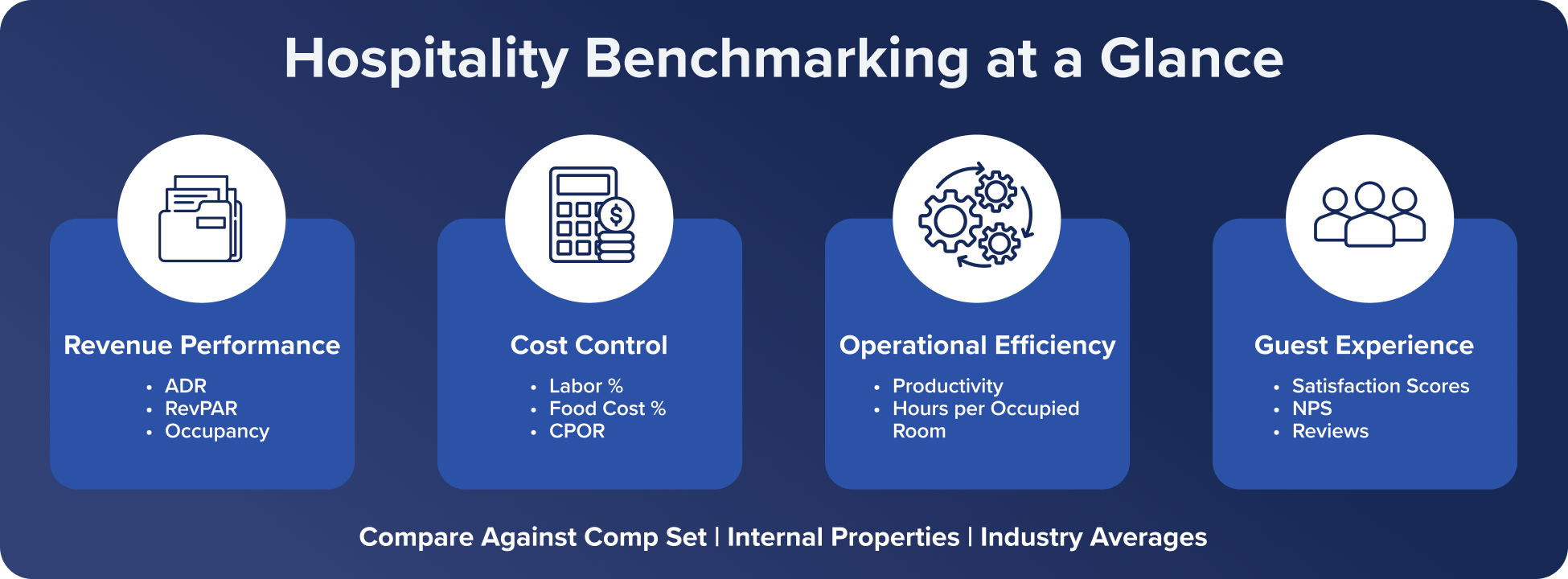
It answers one simple but important question: Are we doing better, worse, or the same as the market?
When comparing hospitality businesses, you can look at things like RevPAR (revenue per available room), labor percentage (cost), operational productivity, or even guest satisfaction. The goal isn’t just to measure. It’s knowledge.
When done right, hospitality benchmarking turns raw data into a plan of action.
Why Hospitality Benchmarking is Important
Benchmarking isn’t about trying to beat your competitors. It’s about knowing where you are so you can act with accuracy.
Identifying Performance Gaps Against the Market
You might think performance is “fine” if you don’t compare it to something else. But benchmarking in the hospitality industry often shows hidden gaps:
- Less occupancy than your competitors
- More expensive per room that is occupied
- Food prices going up more than the average for the segment
These gaps are chances. You can fix things before your margins drop if you can clearly see where your performance is different from industry standards.
Supporting Smarter Revenue and Pricing Decisions
When you base your revenue strategy on comparisons, it works better. If your Average Daily Rate (ADR) is lower than that of similar properties but your occupancy stays the same, you might not be using your pricing power.
Hospitality benchmarking helps revenue teams find the right balance between rate and volume instead of just guessing.
Improving Cost Control and Operational Efficiency
People pay attention to revenue. Costs keep profits safe.
By comparing food cost percentages, labor productivity, and CPOR (Cost Per Occupied Room), you can make sure that high top-line numbers aren’t hiding inefficient operations below.
Aligning Guest Experience with Industry Expectations
Guest satisfaction benchmarks and Net Promoter Scores (NPS) show how your service levels stack up against those of your competitors. If similar properties are getting higher scores, the difference often points to improvements in operations or training.
Hospitality benchmarking makes sure that the guest experience is measured based on facts, not guesses.
Industry Standards Used in Hospitality Benchmarking
Different parts of the business use different standards, but there are a few core benchmarks that always guide decisions.
Revenue and Occupancy Benchmarks
- Average occupancy rates by segment
- ADR performance in relation to the competition set
- Comparing RevPAR rates in local markets
These numbers show how strong the demand is and where the prices are.
Profitability and Cost Benchmarks
- GOP margins by type of property
- Percentages of labor costs
- Ratios of food and drink costs
Industry cost standards make it clear if your costs are in line with those of your competitors.
Operational Efficiency Standards
- Number of rooms cleaned by each housekeeper during each shift
- Table turns in food and drink places
- Hours of work per room occupied
These standards show that there is discipline in the workplace.
Guest Experience and Service Quality Benchmarks
- Average scores for guest satisfaction
- Ratings of online reviews
- NPS by group
You need to compare the quality of your service to what guests in your market tier expect.
Market and Segment-Level Benchmarks
Different types of hotels, like luxury, upscale, midscale, and limited-service, all work in different ways. When comparisons are specific to a segment, hospitality benchmarking works best.
Types of Hospitality Benchmarking
Not every benchmarking looks outside. In the hospitality industry, there are three main types that are used.
Competitive Benchmarking Against a Comp Set
This compares your property to a group of similar properties. It is common in hotel revenue management and very important for positioning performance.
Internal Benchmarking Across Properties or Departments
Groups that own more than one property often compare them to each other. This shows which properties are doing the best and what the best ways to run a business are.
Industry Benchmarking Using Market Averages and Standards
Some operators look at how their performance compares to the average for the whole industry. This method is helpful when there isn’t much competitive set data or when looking at overall health.
Core Hospitality KPIs Used for Benchmarking
The right KPIs are important for good hospitality benchmarking.
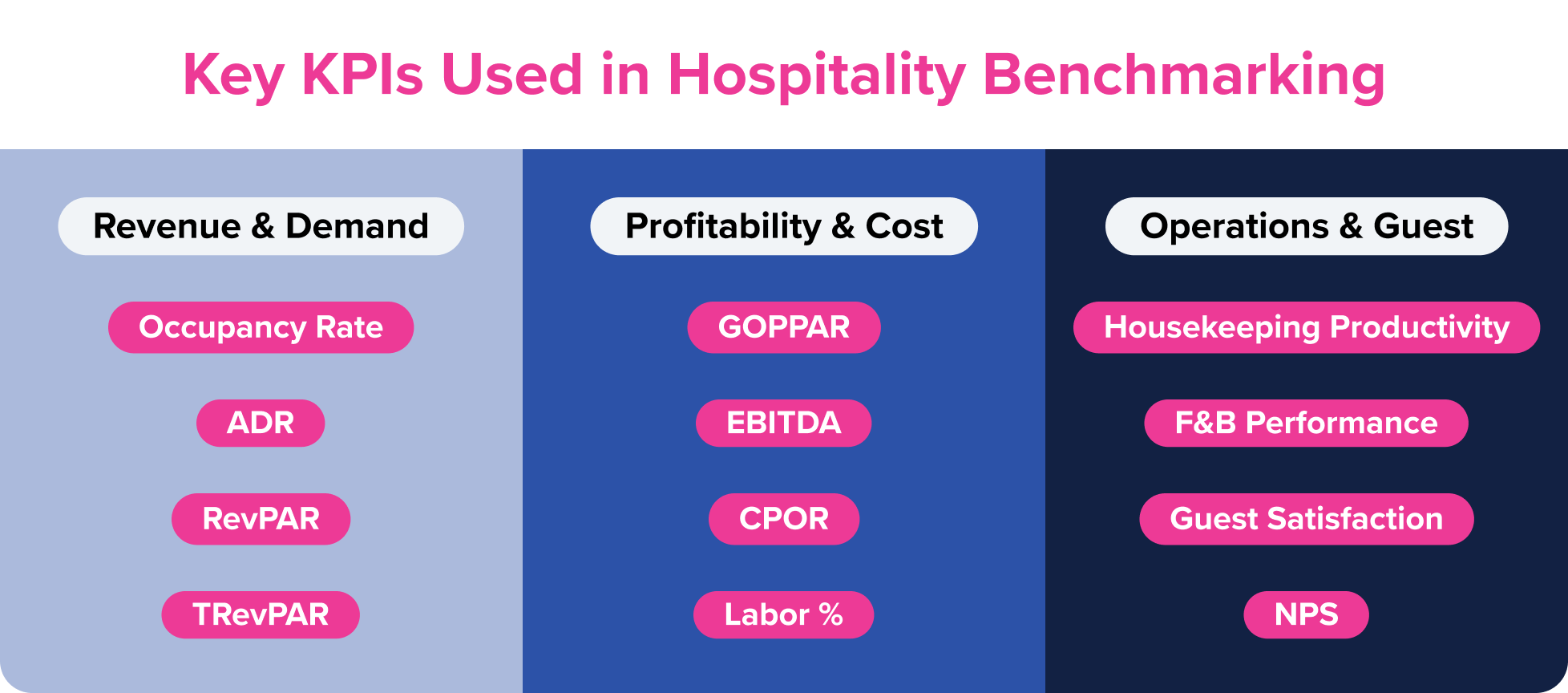
Revenue and Demand KPIs
Occupancy Rate
The percentage of rooms that were sold during a certain time. It measures how well demand is being met.
Average Daily Rate (ADR)
The average amount of money made from each room that is rented out.
Revenue Per Available Room (RevPAR)
ADR times the occupancy rate. RevPAR combines pricing and volume into one measure of performance.
Total Revenue Per Available Room (TRevPAR)
Includes all sources of income, not just rooms. Very important for properties that offer a lot of food and drink or other services.
Profitability and Cost KPIs
Gross Operating Profit Per Available Room (GOPPAR)
Checks how well a business makes money. A key metric for hospitality benchmarking because it links revenue to cost control.
EBITDA and Operating Margin
Show how well the company is doing financially and how well it is doing with investors.
Cost Per Occupied Room (CPOR)
Keeps track of operating costs that are directly related to room sales.
Labor and Food Cost Percentages
Two of the most closely watched cost benchmarks in the hospitality industry. Even small changes in percentages can have a big effect on margins.
Operational and Guest Experience KPIs
Housekeeping Productivity
Rooms cleaned for every hour of work. A clear sign of how well staff are working.
Food and Beverage Performance
Includes the cost of food as a percentage, the margin on drinks, and the profitability of the outlet.
Guest Satisfaction Scores and NPS
Show how operational performance affects how guests see things.
Industry Benchmark Indexes Used in Hospitality
Many indexes are commonly utilized in hospitality benchmarking to assess competitive positioning.
Market Penetration Index (MPI)
Looks at how many people are staying in your place compared to your competitors. If your MPI is over 100, you are doing better than your competitors.
Average Rate Index (ARI)
Compares ADR’s performance to that of its competitors.
Revenue Generation Index (RGI)
Looks at your RevPAR and compares it to that of your competitors. People often think of it as one of the most important indicators of positioning.
How the Hospitality Benchmarking Process Works
When it is organized and consistent, benchmarking works best.
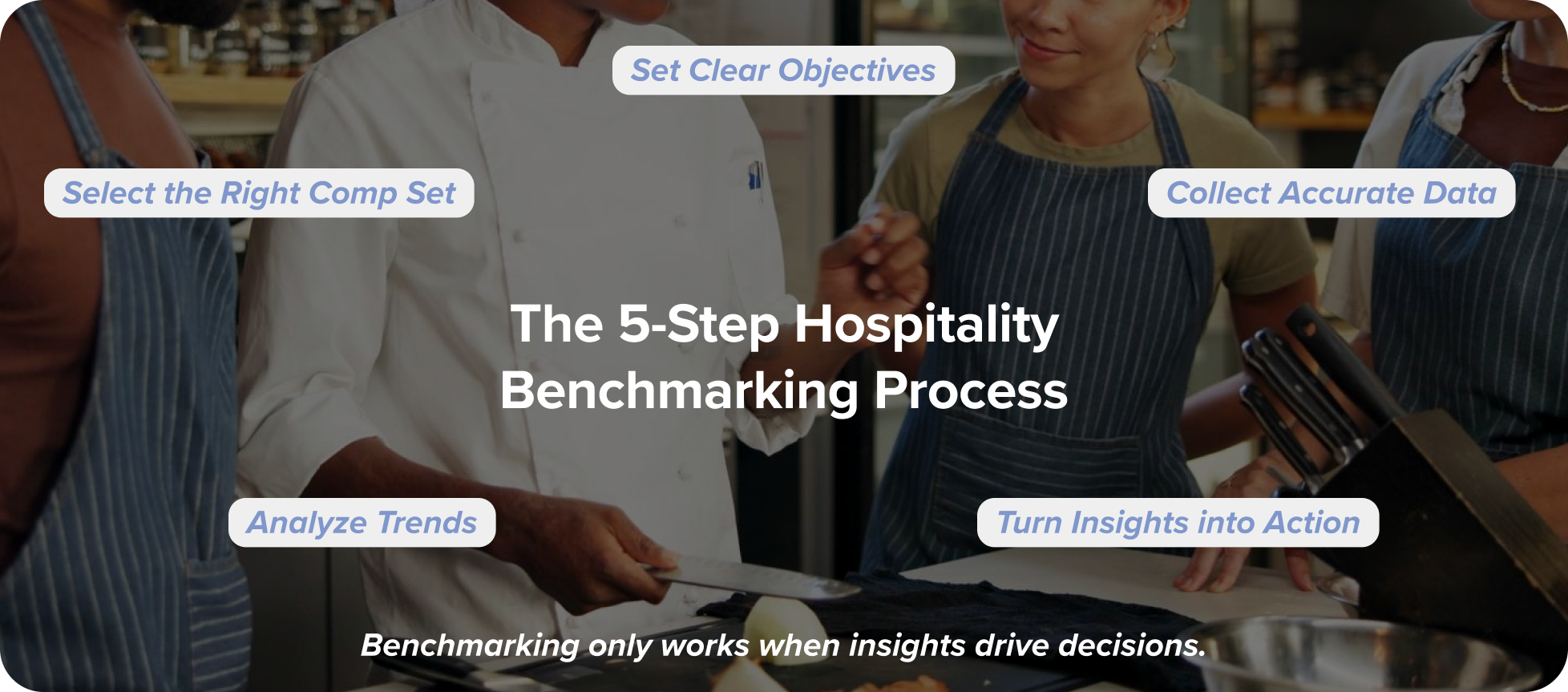
Setting Clear Benchmarking Objectives
Define the goal first. Are you trying to make more money? Strengthen the rate? Cut down on labor costs?
Your goals determine the metrics you keep track of.
Selecting the Right Competitive Set
A comp set should include properties that are similar in size, location, level of service, and target guest.
Bad choice of comparables makes benchmarking less useful.
Collecting Accurate and Comparable Data
For reliable hospitality benchmarking, the data needs to be correct. Reporting that is incomplete or out of sync leads to wrong conclusions.
Advanced tools for procurement and financial analytics help keep data accurate, especially when looking at prices and costs compared to spending in the whole industry.
Analyzing Results and Performance Trends
It’s better to look at trends than just one month at a time. Looking at data over time shows trends and changes in performance.
Turning Benchmark Insights into Action
Benchmarking is only useful when insights are used to make decisions. That could mean changing the way you hire people, renegotiating contracts with suppliers, or fine-tuning your pricing strategies.
Common Challenges in Hospitality Benchmarking
Even experienced operators run into problems.
Inaccurate or Incomplete Data
Errors are common in manual reporting processes. For reliable benchmarking, data must be collected in a consistent and structured way.
Poorly Defined Competitive Sets
When you compare things that are not the same, you get wrong results.
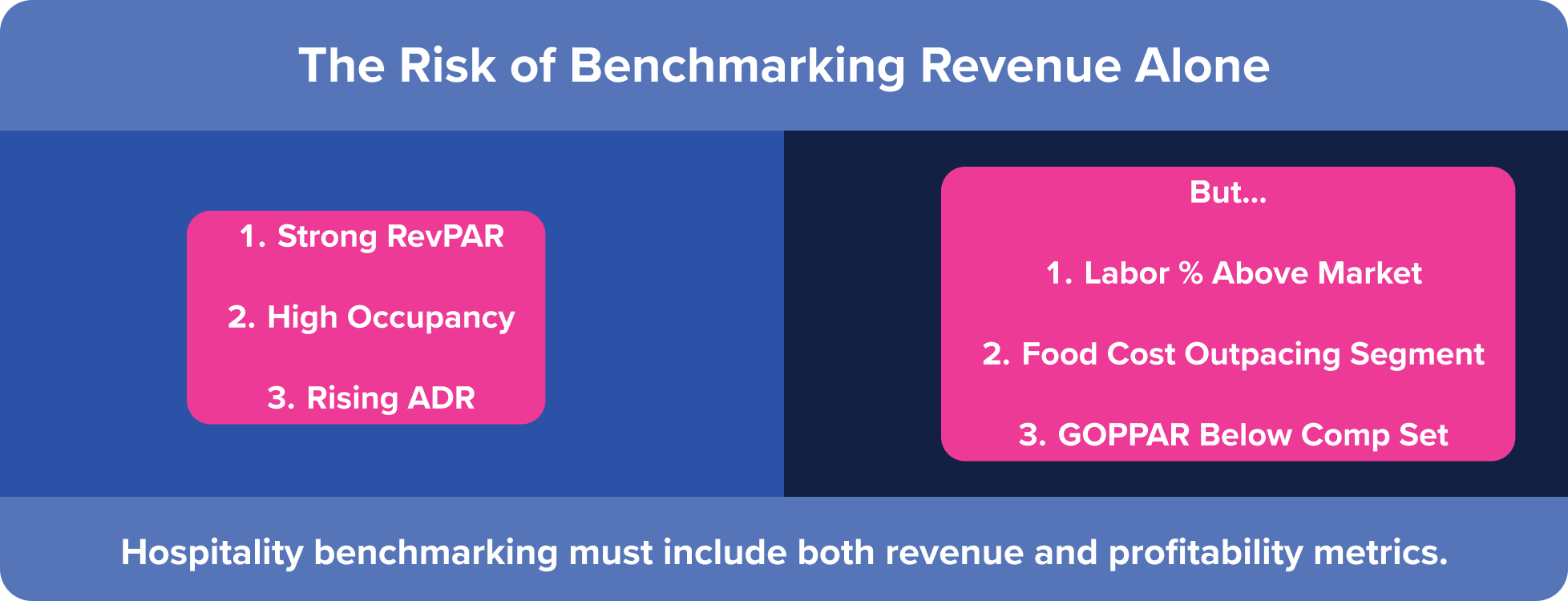
Overreliance on Revenue Metrics Alone
Revenue metrics only tell part of the story. Strong top-line growth can hide shrinking margins if you don’t use cost benchmarking.
Lack of Cost and Profitability Benchmarks
Many hospitality teams keep a close eye on RevPAR but don’t compare GOPPAR or CPOR. Profitability must be part of a full hospitality benchmarking.
Best Practices for Effective Hospitality Benchmarking
You should make benchmarking a regular part of your work.
Benchmark Both Revenue and Costs
Balanced benchmarking makes sure that growth is not only impressive on paper, but also profitable.
Review Benchmarks on a Regular Cadence
Teams can change their plans ahead of time by holding monthly and quarterly reviews.
Compare Like-for-Like Properties
Teams can change their plans ahead of time by holding monthly and quarterly reviews.
Use Benchmarks to Drive Operational Changes
If housekeeping isn’t as productive as the market average, you may need to change your staffing models. If food costs are higher than what is normal for the segment, it may be necessary to rethink how to buy it.
There should always be action after benchmarking.
Final Thoughts
When you do hospitality benchmarking, you don’t compete with your ego. It’s about being smart when you compete.
Operators get a clearer picture by comparing revenue, costs, operational efficiency, and guest experience metrics to meaningful standards. That clarity helps you make better pricing decisions, keep costs under control, and make money more consistently.
In today’s world, data that isn’t compared is useless. Hospitality benchmarking gives you the information you need to turn performance metrics into a strategic advantage.
FAQs
Which KPIs are most important for hospitality benchmarking?
Some of the most important are RevPAR, ADR, occupancy rate, GOPPAR, CPOR, labor cost percentage, and guest satisfaction scores. The right mix will depend on the type of property you have and your long-term goals.
How do hotels choose the right comp set?
Properties in a comp set should be similar in size, location, service level, and target market. The goal is to compare things that are the same.
How often should hospitality benchmarking be done?
Most operators look at benchmarking data every month, and they do more in-depth trend analysis every three and six months.
Can benchmarking improve profitability and guest satisfaction?
Yes. When hospitality benchmarking finds areas where costs are too high or service is lacking, operators can make specific changes that improve both their profits and the experience of their guests at the same time.