
If you’ve ever opened a delivery and thought, this is not what I ordered… and somehow it costs more, you already understand why the restaurant procurement process matters.
Procurement isn’t just about ordering food. It’s everything that happens before, during, and after that order hits your back door. When it’s working, you barely notice it. When it’s not, it shows up fast in your food costs, inventory chaos, and frustrated teams.
Let’s break it down in a way that actually makes sense in a real kitchen.
What is Restaurant Procurement?
The restaurant procurement process is how operators source, purchase, receive, and manage the products they need to run their business.
That includes everything from proteins and produce to paper goods and cleaning supplies. It also covers how you choose suppliers, negotiate pricing, track orders, and verify what you were actually charged.
In simple terms, procurement is the system behind every ingredient that ends up on your plate—and every dollar tied to it.
Why the Procurement Process is Important in Restaurants
Margins in this industry are already tight. Procurement is one of the few areas where small improvements can make a big financial impact.
When your process is dialed in, you’re not over-ordering, you’re not overpaying, and you’re not scrambling when something goes out of stock.
When it’s not? You’re dealing with inconsistent pricing, missing items, last-minute substitutions, and inventory that never quite matches reality.
A strong procurement process helps you:
- Control food and supply costs
- Improve consistency across locations
- Reduce waste and over-ordering
- Catch pricing errors before they hit your bottom line
- Keep operations running without constant fire drills
Key Stages of the Restaurant Procurement Process
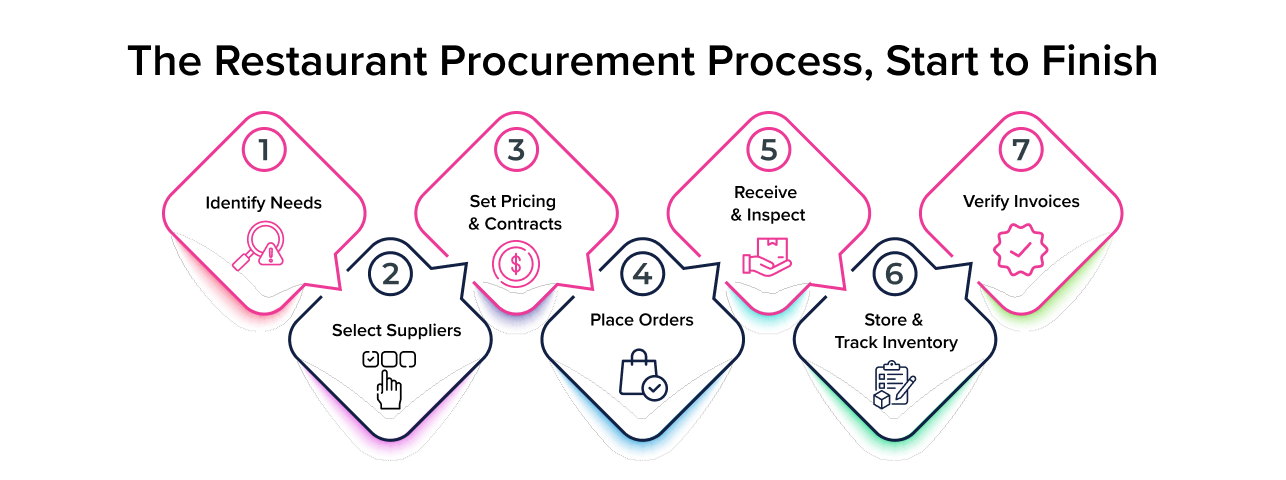
Identifying Needs and Demand Planning
Everything starts here.
You’re looking at sales trends, menu mix, and upcoming demand to figure out what you actually need. Not what you think you need—what you’re going to use.
This is where over-ordering or under-ordering usually begins, so accuracy matters more than people realize.
Supplier Research and Selection
Not all suppliers are created equal.
You’re evaluating based on pricing, reliability, product quality, and how they perform when things don’t go perfectly (because they won’t).
The best operators don’t just look for the lowest cost—they look for consistency and communication.
Contract and Pricing Agreements
This is where expectations get locked in.
You’re setting pricing terms, delivery schedules, and product specs. If this step is rushed or unclear, it almost always shows up later as pricing discrepancies or substitutions.
Clear agreements upfront save a lot of back-and-forth later.
Placing Purchase Orders
This is the execution step.
Orders need to be accurate, consistent, and aligned with your actual demand. Manual ordering leaves room for mistakes, especially across multiple locations or vendors.
Even small errors here can create ripple effects through inventory and cost tracking.
Receiving and Inspecting Deliveries
This is where theory meets reality.
What you ordered and what shows up are not always the same.
Teams need to check quantities, product quality, and temperatures at delivery. Skipping this step is how issues slip through and become your problem later.
Inventory Storage and Stock Control
Once products are in-house, they need to be tracked and stored properly.
That means organizing inventory, rotating stock, and keeping counts accurate. If inventory isn’t managed consistently, your data becomes unreliable—and so do your future orders.
Invoice Verification and Payment
This is one of the most overlooked (and most expensive) steps.
You’re matching invoices against what you ordered and what you received.
Pricing errors, missed credits, and incorrect fees happen more often than most operators realize. Without a process to catch them, you’re just absorbing those costs.
Step-by-Step Breakdown of the Procurement Workflow
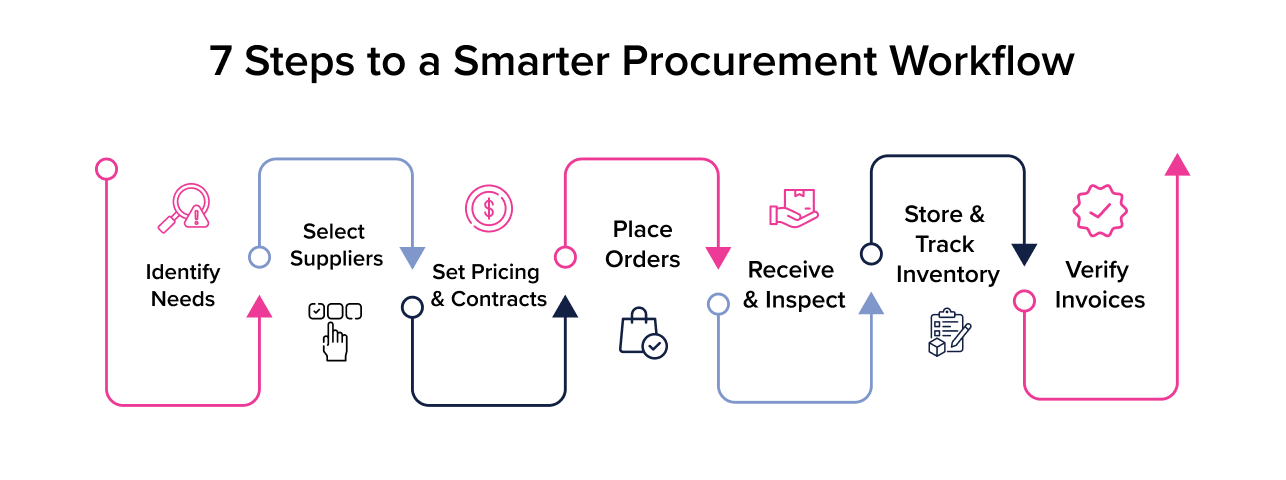
Step 1: Define Product and Supply Requirements
Before you order anything, you need a clear picture of what’s actually moving in your kitchen.
What’s selling? What’s sitting? What’s about to run out faster than expected?
If you’re just eyeballing it or going off last week’s order, you’re probably overbuying something and running short on something else. The goal here is simple: order what you’ll use, not what feels safe.
Step 2: Evaluate and Approve Suppliers
Every operator has that one supplier they want to love… until something shows up late, short, or swapped without warning.
This step is about being honest about who actually delivers (literally and figuratively). Pricing matters, sure, but so does consistency, communication, and how they handle problems when things go sideways.
Because they will.
Step 3: Establish Ordering Procedures
If ordering looks different every time depending on who’s working, that’s where mistakes start creeping in.
You want a process that’s repeatable. Same cadence, same approach, same expectations. That way you’re not reinventing the wheel every order day or chasing down “who ordered this?” later.
Step 4: Manage Orders and Deliveries
Once the order is placed, it’s not a “set it and forget it” situation.
Things change. Items get subbed. Deliveries get pushed.
Keeping an eye on orders before they hit your door gives you a chance to adjust instead of scrambling mid-shift because something didn’t show up.
Step 5: Inspect Goods and Ensure Quality
This is the moment of truth.
Boxes come in, everyone’s busy, and it’s tempting to just sign and move on. That’s usually when mistakes sneak through.
Take the extra minute. Check counts. Open a case or two. Make sure what you got is actually what you ordered—and that it’s usable.
Step 6: Match Invoices with Orders
This is where a lot of money quietly slips away.
Prices don’t always match what was agreed to. Fees show up. Credits go missing.
If no one’s checking invoices against orders and deliveries, those small differences just become part of your costs… whether they should be or not.
Step 7: Track Procurement Records
This part isn’t flashy, but it’s what separates reactive operators from the ones who actually stay ahead.
When you can look back at what you ordered, what you paid, and how suppliers performed, patterns start to show up.
And once you can see the patterns, you can actually do something about them.
Common Bottlenecks in the Procurement Process
Delayed Deliveries
You plan your prep around what’s supposed to arrive… and then it doesn’t.
Now you’re adjusting on the fly, 86’ing items, or sending someone on a last-minute run just to get through service.
Delays happen, but when you don’t have visibility into what’s coming (or not coming), they hit a lot harder than they should.
Order Inaccuracies
You ordered 10 cases. You got 8. Or the wrong item entirely. Or a “close enough” substitute no one approved.
None of those scenarios are rare.
Most of the time, it’s not one big mistake—it’s small inconsistencies in how orders are placed or communicated that add up over time.
Pricing Discrepancies
This one’s sneaky.
The price you expected and the price on the invoice don’t always match, and unless someone is actively looking for it, it slips through.
A few cents here, a couple dollars there… multiplied across hundreds of items and orders, it starts to matter a lot more than people think.
Inventory Mismatches
If your inventory says you have it, but your shelf says otherwise, something broke in the process.
It could be receiving, it could be counting, it could be waste that never got tracked.
Either way, bad inventory data leads to bad ordering decisions, and then the cycle keeps going.
How Software Streamlines Restaurant Procurement
Automate Purchase Orders
Manually building orders every time leaves too much room for human error.
With automation, you’re not starting from scratch—you’re working from real usage patterns. That alone cuts down on missed items, duplicates, and those “why did we order so much of this?” moments.
Enhance Supplier Price Visibility
You shouldn’t have to guess if you’re being charged correctly.
When pricing is clearly tracked against your agreements, discrepancies stand out instead of hiding in plain sight.
It shifts you from hoping things are right to actually knowing.
Improve Order Accuracy
When your ordering is tied to real data—sales, inventory, usage—it gets a lot more consistent.
That means fewer surprises when deliveries show up and fewer adjustments mid-week because something didn’t line up.
Simplify Invoice Matching
No one wants to sit there manually checking invoices line by line.
But skipping it is how errors slip through.
The right tools take that manual work off your plate and flag anything that doesn’t match, so you’re only reviewing what actually needs attention.
Provide Real-Time Procurement Insights
Instead of waiting until the end of the month to see what went wrong, you can spot trends as they’re happening.
Pricing shifts, usage spikes, supplier issues—it’s all easier to catch early when you’re not working off outdated information.
Final Words
Procurement isn’t the most glamorous part of running a restaurant, but it’s one of the most impactful.
It touches your costs, your consistency, and how smoothly your team operates day to day.
When the process is loose, you feel it everywhere. When it’s tight, things just… work better. Orders are cleaner, inventory makes sense, and costs don’t feel like they’re constantly creeping up for no reason.
And if you can get to that point, you’re already ahead of a lot of operators.
Click here to connect with the InsideTrack team and see how better visibility into your procurement process can help you control costs and catch issues before they impact your bottom line.
FAQs
How do restaurants control procurement costs?
It usually comes down to discipline more than anything else. Keeping inventory tight, checking invoices regularly, and not over-ordering “just in case” all play a role. It’s the small habits done consistently that keep costs in check.
What causes delays in restaurant procurement?
Sometimes it’s the supplier. Sometimes it’s internal—late orders, unclear communication, or missed cutoffs.
Most delays aren’t random. They’re usually tied to a gap somewhere in the process.
What is the best way to prevent order inaccuracies?
Consistency.
When the same process is followed every time, with clear expectations around quantities and timing, there’s less room for things to go wrong.
How can restaurants avoid invoice mismatches?
By actually checking them.
Comparing invoices to what was ordered and received is the only way to catch errors. If that step gets skipped, mistakes just become part of your costs.
When should a restaurant consider procurement software?
Usually when things start feeling messy.
If orders are inconsistent, pricing is hard to track, or too much time is spent fixing mistakes, that’s a sign the current process isn’t holding up anymore.
Can small restaurants benefit from procurement automation?
They can.
Even a smaller operation feels the impact of pricing errors, waste, and inconsistent ordering. Having a clearer process and better visibility helps at any size.