

If you run a restaurant, you already know margins can be thin. A good restaurant cost analysis is the difference between steady profit and constant stress. In this post, I’ll walk through what restaurant cost analysis actually means, the key metrics you should track, a step-by-step way to run an analysis, and practical fixes you can use right away to boost your margins. No fluff, just the stuff that works on the floor and in the back office.
What is Restaurant Cost Analysis and Why Does It Impact Profitability?
Restaurant cost analysis is the process of figuring out how much it costs to run your business, including food, labor, and overhead, and then comparing those costs to sales so you can make smart choices. You can keep an eye on waste, set smart prices, hire the right people, and protect your margins when you know where your money is going. It’s not just about accounting; it’s also about the tactical playbook that makes money from data.
Three Core Restaurant Cost Categories
To make things a bit easier to digest, we can generally group restaurant costs into three main buckets. Nail these in your restaurant cost analysis, and you’re golden.
Cost of Goods Sold (COGS)
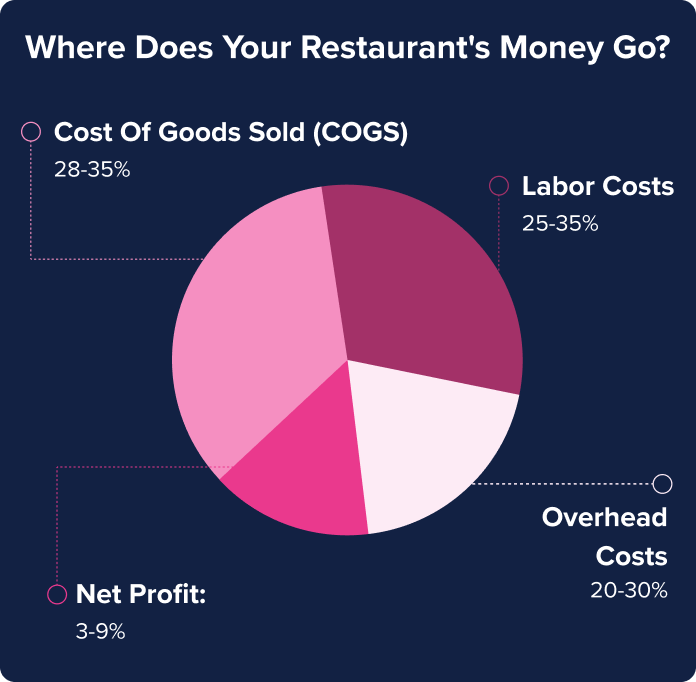
This is the direct cost of the food and beverages you sell. We’re talking about everything that goes into making the dishes on your menu—ingredients, spices, garnishes, all of it. Your COGS is probably going to be your single largest expense category. For most restaurants, you’re looking at 28-35% of your revenue. Track it wrong, and you’re throwing cash in the trash with waste or theft.
Labor Cost Analysis
Your second major cost category is labor. This includes everyone on your payroll—cooks, servers, hosts, managers, dishwashers. You’re also looking at payroll taxes, benefits, and training costs. Labor costs typically run 25-35% of revenue, depending on your restaurant type. It’s not just payroll; factor in overtime, benefits, and scheduling slips.
Overhead Costs
Then you’ve got everything else—rent, utilities, insurance, equipment, marketing, licenses, software subscriptions. These are your fixed and semi-variable costs that keep the doors open but don’t directly go into your food. Overhead usually sits around 20-30% of revenue, but it varies wildly depending on your location and setup. These are the sneaky ones that often run 25-35% of sales, but they’re fixed, so optimizing here feels like free money.
Key Restaurant Cost Metrics
Now we’re getting into the actual tools you use to understand your restaurant cost analysis. These metrics are like your restaurant’s vital signs and tell you if you’re speeding or stalling.
Food Cost Percentage
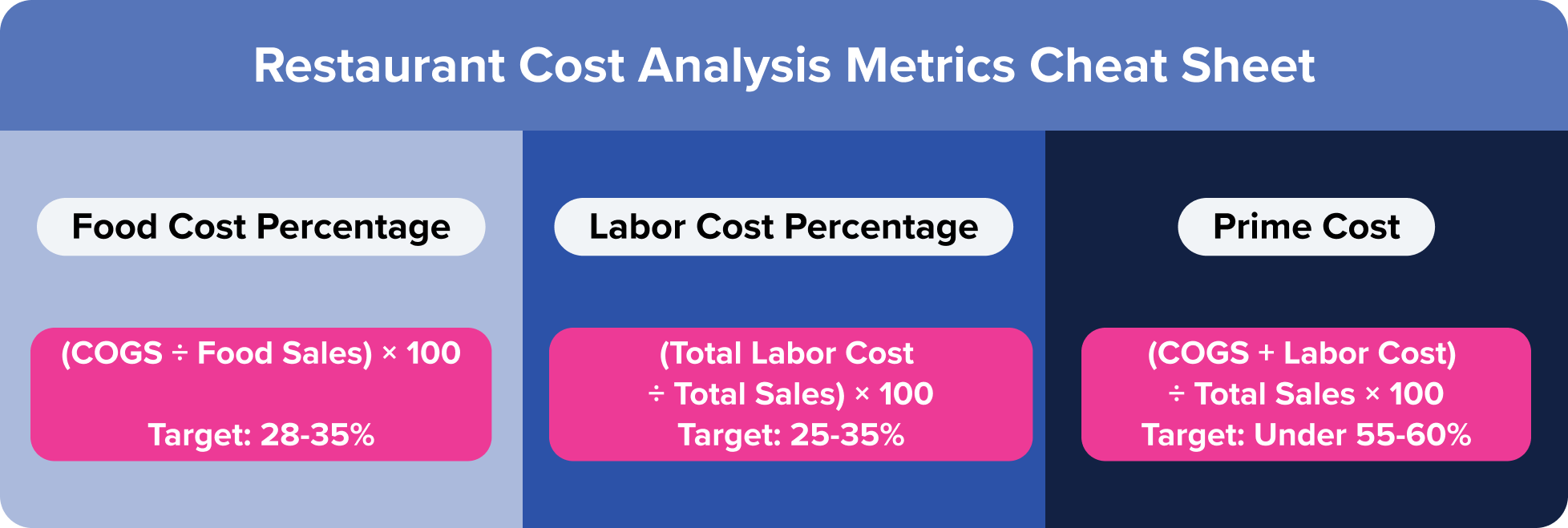
This tells you how much of your food sales revenue is spent on ingredients. You calculate it by dividing the cost of your food sold by your total food sales and multiplying by 100. Most restaurants aim for a food cost percentage between 28% and 35%, but this can vary depending on your concept. Higher? Time to tweak suppliers or portions.
Formula: (COGS for period ÷ Food sales for period) × 100
Example: If you sold $50,000 in food and your COGS was $17,500, the food cost percentage = (17,500 ÷ 50,000) × 100 = 35%.
Labor Cost Percentage
Similar to food cost, this metric shows how much of your revenue goes towards your labor expenses. You calculate it by dividing your total labor costs by your total sales and multiplying by 100. A good target range is typically between 25% and 35%, depending on your restaurant type. Over-scheduling during slow hours kills it. Don’t forget to include payroll taxes and benefits in the numerator.
Formula: (Total labor cost ÷ Total sales) × 100
Prime Cost
This is a big one! Prime cost is simply your Cost of Goods Sold (COGS) plus your total labor costs. Because food and labor are your two largest and most controllable expenses, monitoring your prime cost gives you a powerful insight into your overall profitability. Many successful restaurants aim to keep their prime cost under 55-60% of sales. If it’s higher, profitability’s toast.
Formula: Food cost + Beverage cost + Labor cost (or sometimes Food + Labor) — then divide by sales for the ratio.
Menu Costing
This is the process of figuring out the exact cost of each ingredient in every single menu item. It’s super detailed but absolutely essential for setting profitable prices. You need to account for everything, down to the last pinch of salt or dash of oil! Good menu costing feeds menu engineering and pricing decisions.
Restaurant Cost Benchmarks
Benchmarks are like a yardstick for your restaurant’s performance. They’re industry averages that help you see how you stack up against other similar businesses.
- Food Cost: 28-35%
- Labor Cost: 25-35% (quick-service often 25-30%)
- Prime Cost: 55-65%, ideally under 60%
- Overhead: 25-35%
- Profit: Aim for 10%+ net after all.
Compare yours monthly—beat these, and you’re crushing it. Set realistic internal benchmarks first; external numbers help validate if you’re an outlier.
How to Perform a Step-by-Step Restaurant Cost Analysis
Ready to roll up your sleeves and do some digging? Here’s your no-BS guide to restaurant cost analysis.
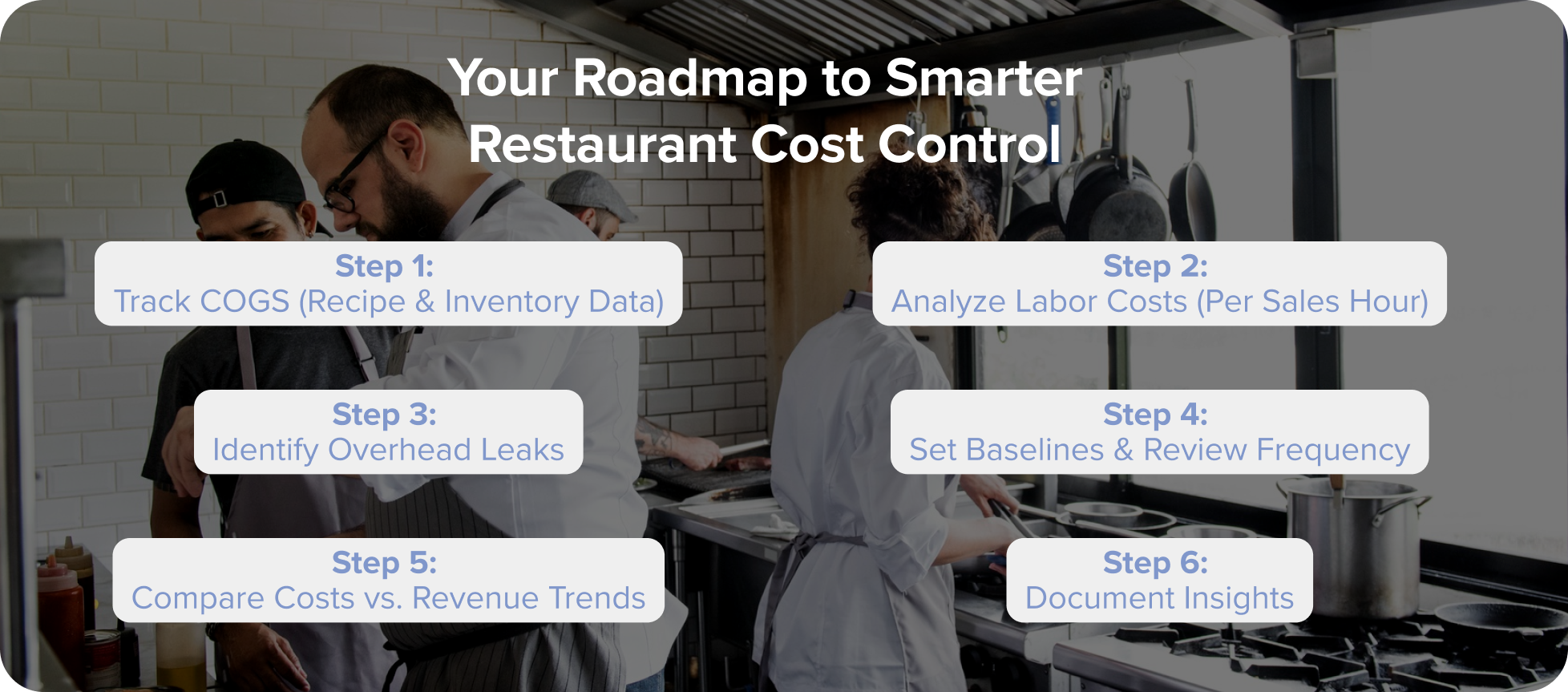
Track COGS With Recipe and Inventory Data
Start with recipes: list every ingredient per dish, cost it out. Inventory weekly or bi-weekly—beginning inventory + purchases – ending inventory = COGS. Tools like apps make it painless. Build standardized recipe cards with exact ingredient amounts and yield. Use inventory counts to reconcile purchases vs. usage and catch theft/waste.
Analyze Labor Costs Per Sales Hour
Break labor by shift: dollars per hour divided by sales per hour. If it’s spiking during lulls, cut shifts or cross-train. Compare scheduled hours to actual sales by daypart to spot overstaffing or understaffing. Track productivity metrics: covers per labor hour, tickets per labor hour, or average check per labor hour.
Identify Overhead and Expense Leaks
Scan bills: utilities too high? Negotiate rent. Marketing ROI sucking? Ditch it. Audit recurring invoices: Are monthly subscriptions still needed? Review utilities and equipment maintenance schedules — inefficient equipment can spike costs. Watch for one-off expenses that become recurring. Hunt for the 1% leaks that add up.
Set Cost Baselines and Review Frequency
Establish your “normal” from last quarter. Review weekly for food/labor, and monthly full dive for overhead. Use rolling 4- and 13-week averages to smooth seasonal swings. Schedule quick daily check-ins (sales vs. forecast) and deeper weekly reviews (inventory & labor performance).
Compare Costs Against Revenue Trends
Costs up but sales flat? Red flag. Trend it over 3-6 months to spot patterns. Match your cost data to sales patterns: Are higher labor costs tied to low-sales shifts? Look at menu mix changes: did lower-priced items sell more and push margin down? Use variance analysis (actual vs. expected) to isolate causes quickly.
Document Insights for Ongoing Cost Control
Log everything in a simple sheet. Review in team huddles—make it a habit. Keep a simple log of actions taken and results (e.g., changed portion size, renegotiated supplier). Track impact on cost metrics so you know what actually moves the needle. Make the log accessible to managers so learnings are shared across shifts and locations.
Using Cost Analysis to Improve Restaurant Profit Margins
Once you’ve analyzed, act. Use insights to negotiate vendors, optimize schedules, and portion better. Owners who do this see margins jump 3-5% easy. It’s about control, not cuts. Cost analysis is the foundation for continuous improvement. Once you can measure reliably, you can:
- Reduce waste with better purchasing and portion control.
- Schedule staff against sales patterns to lower labor % without hurting service.
- Adjust pricing or menu to improve contribution margin.
- Re-negotiate supplier contracts using purchase history as leverage.
Small changes compound: a 1–2% improvement in food cost or labor cost can meaningfully boost the bottom line.
Menu Engineering Through Cost Analysis
Menu engineering uses your cost data to supercharge profits.
Identify High-Profit and Low-Margin Menu Items
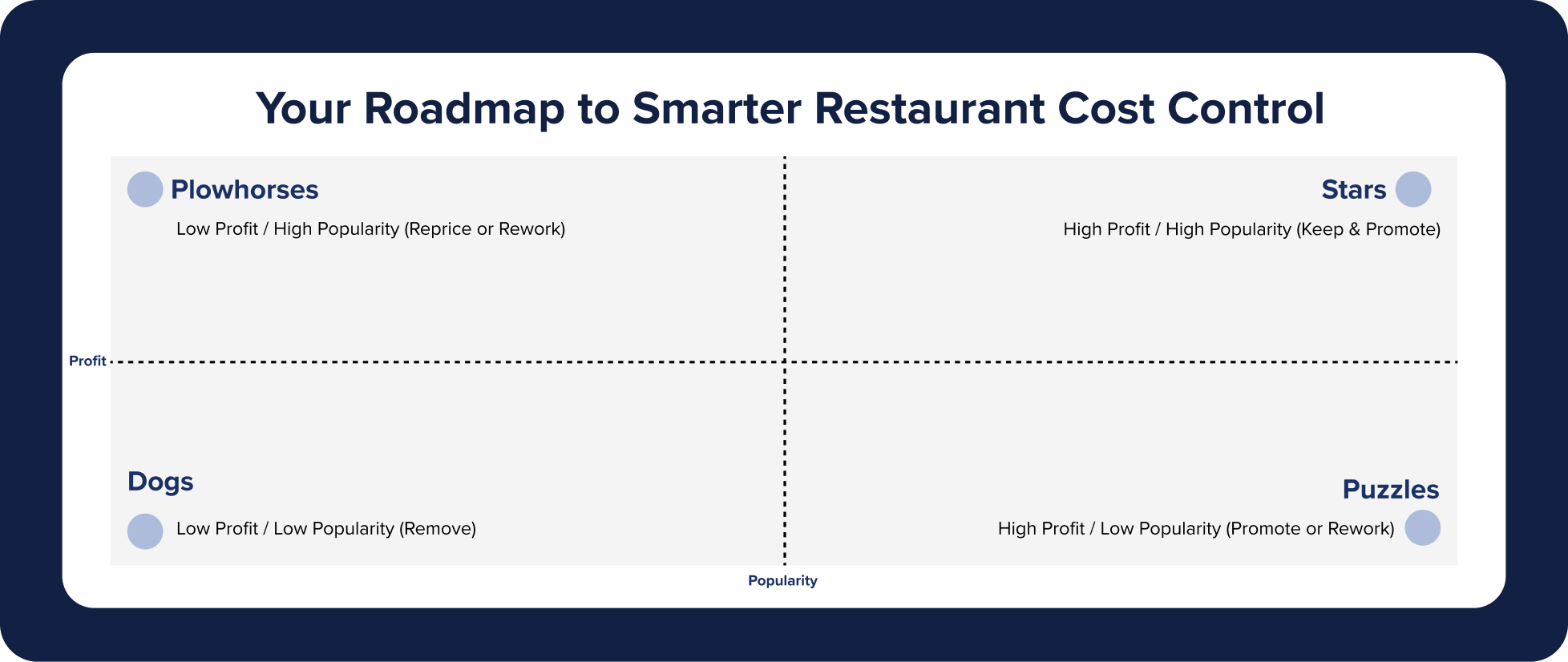
Use menu costing to calculate contribution margin per dish (menu price − food cost). Combine that with popularity (sales mix) to classify items: Stars (high profit, high popularity), Plowhorses (low profit, high popularity), Puzzles (high profit, low popularity), Dogs (low profit, low popularity). Calculate popularity x profitability.
Decide When to Reprice, Rework, or Remove Dishes
Low-margin fave? Reprice subtly or swap cheap ingredients. Dogs? Ax ’em. Reprice when costs increase, and customers will tolerate it (test on similar items first). Rework recipes to lower ingredient costs without changing perceived value — swap ingredients, reduce waste, or adjust portioning. Remove persistent low-margin, low-popularity items — space on the menu is valuable.
Balance Menu Profitability with Customer Demand
Don’t chase margin at the expense of guest satisfaction. Some loss-leaders (popular, low-margin items) can drive covers and overall sales. Test changes in small batches and measure the impact on the average check and covers before rolling out. Don’t kill crowd-pleasers. Mix 70/30 high-profit to anchors.
Common Restaurant Cost Analysis Mistakes to Avoid
We’ve all been there—don’t repeat these common restaurant cost analysis blunders.
Focusing Only on Food Costs Instead of Prime Costs
Food matters, but ignoring labor means missing half the story. Prime cost ties food and labor to sales and gives you a clearer profitability picture. Food’s easy, but ignore labor and prime hits 70%+.
Ignoring Labor Productivity and Sales Trends
Under-scheduling hurts service; over-scheduling hurts margins. Use sales history to staff intelligently and track productivity metrics. Labor costs in isolation are meaningless. A restaurant that spends $10,000 on labor for $50,000 in revenue is in a different situation than one that spends $10,000 for $100,000 in revenue. Smart restaurant cost analysis looks at labor productivity.
Failing to Review and Optimize Overhead Costs
Overhead may feel fixed, but there are usually savings available in contracts, utilities, and subscriptions if you look. Is rent fixed? Shop it yearly. Overhead is often the forgotten category. Owners focus on food and labor and let overhead creep up over time. Review your overhead regularly.
Relying on Outdated Data
Using old prices or stale recipes skews your analysis. Update ingredient prices, yields, and recipes regularly. Prices change, so update recipes quarterly. Your cost analysis needs to be based on current numbers.
Failing to Benchmark Costs Over Time
A snapshot is useful, but trends tell the story. Benchmarks and rolling averages help identify gradual leaks that a single-period review misses. One month ain’t enough. Track trends. It’s not enough to know your numbers for this month. You need to know how they’ve changed.
Turning Restaurant Costs into Financial Control
The goal of restaurant cost analysis isn’t micro-managing every cent — it’s building predictable, repeatable financial control. When you measure the right things regularly:
- Forecasting gets easier
- Cash flow stabilizes
- Managers make better trade-offs between cost and service
- Scaling (adding locations) becomes less risky because you can replicate processes that work
Start small: pick one or two metrics (food cost % and labor %), get them consistent, then expand from there. That’s the difference between running a restaurant and being run by your restaurant.
Frequently Asked Questions
What is a Good Prime Cost Percentage for Restaurants?
Most restaurants aim for a prime cost between 50-60% of revenue. Some can get lower, some run higher, depending on their concept. But generally, if you’re above 60%, you’ve got a problem that needs fixing. Prime cost targets vary by concept, location, and price point. Many full-service restaurants aim for a prime cost between roughly 55–65% of sales; fast-casual and quick-service often target a bit lower. The best target for you depends on rent, desired profit margin, and service level — use it as a starting point, not an absolute.
How Often Should Restaurants Perform Cost Analysis?
That depends on your operation, but I’d say weekly at a minimum for food and labor. Monthly for overhead. The more frequently you’re analyzing restaurant costs, the faster you catch problems and can respond. Perform daily sales checks and weekly food & labor reviews. Do a full cost analysis (including inventory reconciliation and overhead review) at least monthly. Quarterly deeper dives help with strategy and supplier renegotiations.
Can Cost Analysis Help Multi-Location Restaurants Scale Profitably?
Absolutely. In fact, restaurant cost analysis is probably even more important for multi-location operations. You need to see which locations are performing, which are struggling, and why. You can use what’s working at one location to improve others. Restaurant cost analysis at scale is how you build a sustainable multi-unit brand. Consistent restaurant cost analysis across locations reveals which units are operating efficiently, where processes need tightening, and which menu items perform best. It also gives you data to standardize recipes, purchasing, and staffing — the building blocks for reliable scaling.