
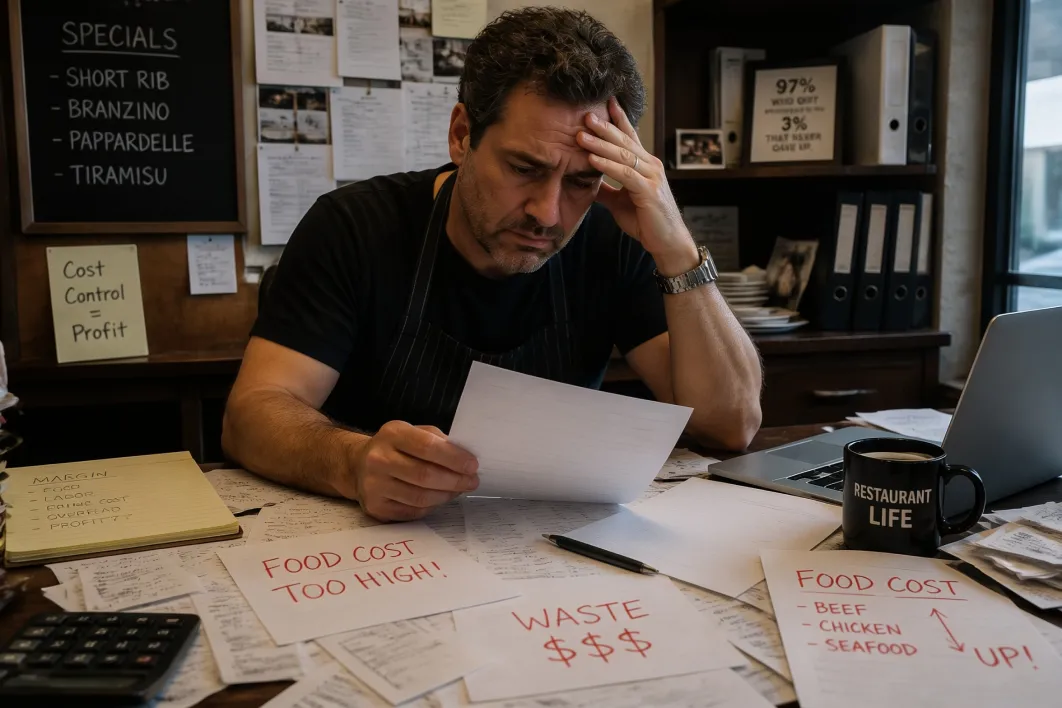
If you’re responsible for purchasing across multiple restaurants, hotel kitchens, casinos, or other large foodservice operations, you know food costs are never static. Prices change, invoices don’t always match contract pricing, products get wasted, and inventory doesn’t always tell the full story.
On their own, those issues might seem manageable. But when they happen across dozens of locations, they start adding up fast. A pricing discrepancy here, a missed rebate there, or a little extra waste in every kitchen can quietly chip away at your margins month after month.
That’s what makes food cost problems so difficult to manage. They’re rarely caused by one major mistake. More often, they’re the result of dozens of small issues happening throughout your purchasing, inventory, and kitchen operations. The challenge isn’t knowing that costs are increasing. It’s understanding exactly why they’re increasing and where those losses are coming from.
In this guide, we’ll look at the most common food cost problems affecting hospitality operators, why they have such a significant impact on profitability, and practical ways to identify and eliminate them before they become much bigger financial headaches.
What Are Food Cost Problems?
Food cost problems are anything that causes your operation to spend more on food than necessary or prevents you from getting the full value from every purchasing dollar.
Some issues happen in the kitchen. Over-portioning, spoilage, recipe inconsistencies, theft, and inaccurate inventory counts can all increase food costs without anyone realizing how much they’re affecting the bottom line.
Others start much earlier in the purchasing process. Distributor pricing discrepancies, invoice errors, off-contract purchases, missed rebates, and limited visibility into supplier spending can all drive costs higher before ingredients ever reach the kitchen.
The reality is that most operators are dealing with both at the same time. That’s why food costs can continue climbing even when your teams are working hard to control them.
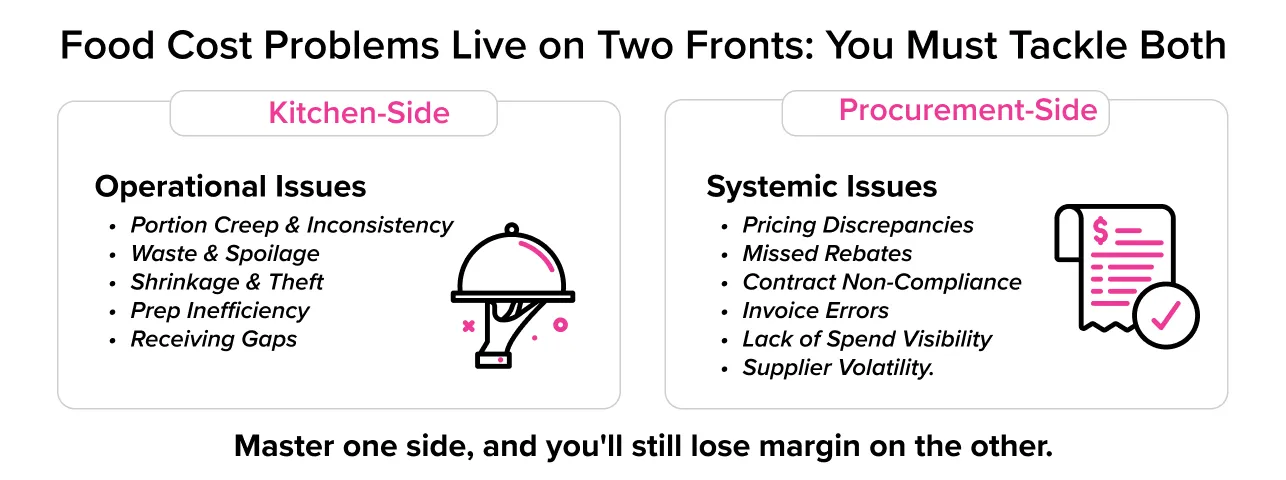
Generally, food cost problems fall into two categories:
- Kitchen-side problems: Operational issues such as waste, spoilage, inconsistent portion sizes, recipe deviations, theft, and poor inventory management.
- Procurement-side problems: Purchasing-related issues including pricing discrepancies, invoice errors, contract compliance issues, missed rebates, and limited visibility into supplier spending.
Understanding where those problems originate is the first step toward fixing them. Once you know whether the biggest opportunities are in your kitchens, your procurement process, or both, you can start making changes that improve profitability instead of simply reacting to rising food costs.
Why Food Cost Problems Hurt Hospitality Profit Margins
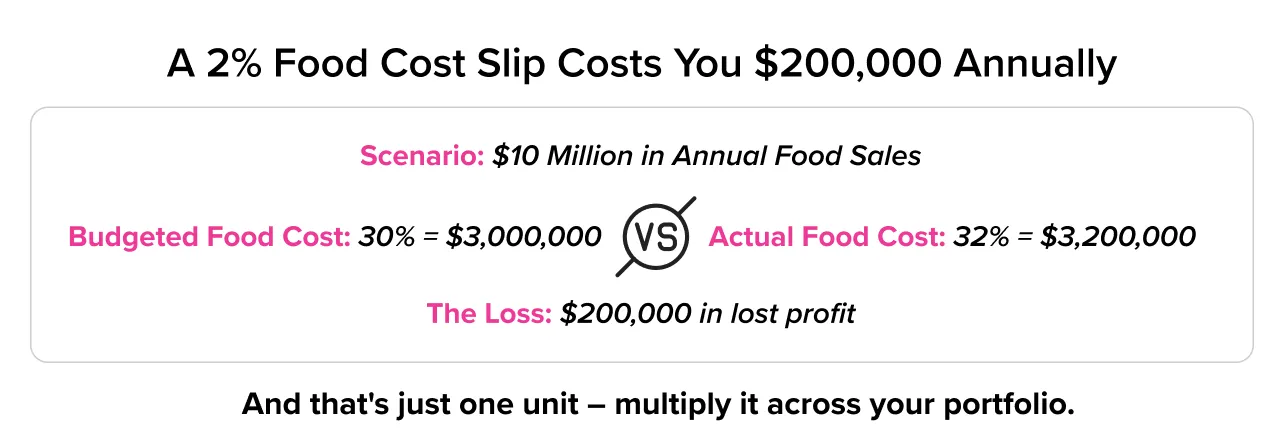
The hospitality industry is notoriously a low-margin business. Full-service restaurants, for instance, often operate with net profit margins between 3% and 5%. Even in hotels and casinos, where F&B might be one of many revenue streams, the F&B departments themselves are frequently squeezed. When food cost problems push your cost of goods sold (COGS) up by even 1% or 2%, you’re not just losing a sliver of profit – you could be losing a third or even half of it.
Consider this: if your operation generates $10 million in food sales and your food cost runs at 32% instead of the budgeted 30%, that’s an annual loss of $200,000 walking out the door. Scale that across a 50-unit chain or a casino with multiple outlets and banquet services, and food cost problems quickly become a multi-million-dollar concern. Beyond the direct financial loss, these issues erode confidence in your financial forecasts, create friction between operations and finance teams, and make accurate planning nearly impossible. When you can’t trust your numbers, making sound business decisions becomes a gamble.
The Top 10 Food Cost Problems Hurting Your Margins
Even with negotiated pricing in place, invoices don’t always reflect the agreed-upon cost. A few cents on one item may not seem like much, but across thousands of purchases and multiple locations, those discrepancies can become a significant expense.
The challenge is that most teams simply don’t have the time to manually review every invoice line by line. Without a process for validating pricing, errors often go unnoticed and continue month after month.
1. Distributor Pricing Discrepancies and Invoice Errors
This is shockingly common. Negotiated contract prices often don’t match what appears on invoices. Even small discrepancies, multiplied across thousands of cases weekly, add up fast. Many operators lack the bandwidth to audit every line item, allowing these pricing errors to become costly food cost problems.
2. Contract Non-Compliance and Missed Rebates
Supplier contracts and rebate programs are designed to help operators reduce costs, but only if purchasing stays aligned with those agreements.
Buying the wrong item, ordering through the wrong distributor, or falling short of program requirements can mean leaving rebate dollars on the table. These missed opportunities don’t always show up as obvious losses, but they still have a direct impact on overall profitability.
3. Lack of Spend Visibility Across Multiple Distributors
Most enterprise foodservice operations rely on more than one distributor. Managing purchases across broadline suppliers, specialty vendors, and local providers often means working from multiple reports, systems, and invoice formats.
When purchasing data is scattered, it’s difficult to identify spending trends, compare pricing, or spot opportunities to consolidate purchases. Without a complete picture, making informed procurement decisions becomes much more challenging.
4. Receiving and Delivery Verification Gaps
A shipment arrives, the delivery is accepted, and everyone moves on to the next task. But was every product delivered? Were substitutions approved? Was damaged product properly documented?
When receiving procedures aren’t consistent, shortages, damaged items, and incorrect deliveries can easily become hidden costs that never get recovered.
5. Portion Creep and Inconsistent Recipe Execution
Not every food cost problem starts with purchasing. Some begin on the line.
An extra ounce of protein, a heavier scoop of cheese, or inconsistent recipe execution may seem insignificant during a busy service. Across hundreds or thousands of meals, though, those small differences can noticeably increase food costs, especially in multi-unit operations where consistency varies from location to location.
6. Inventory Shrinkage, Waste, and Spoilage
Every product that ends up in the trash represents money your operation can’t recover.
Whether it’s spoilage from over-ordering, unnecessary prep waste, inaccurate inventory counts, or product loss, shrinkage steadily increases food costs without generating any additional revenue. Strong inventory practices help identify these issues before they become recurring problems.
7. Outdated Menu Pricing vs. Rising Ingredient Costs
Food costs rarely stay the same for long, but menu prices often do.
When ingredient costs increase and pricing isn’t reviewed regularly, margins begin to shrink. Operators who consistently monitor both purchasing costs and menu performance are in a much stronger position to protect profitability without relying on reactive pricing decisions.
8. Variance Between Actual and Ideal Food Cost
Your ideal food cost reflects what you should be spending based on recipes, portion sizes, and sales. Your actual food cost reflects what was actually spent.
The difference between those two numbers often tells the real story. Large variances typically point to issues such as waste, purchasing inefficiencies, inventory inaccuracies, or inconsistent execution somewhere within the operation.
9. Supplier Price Volatility and Market Inflation
Commodity markets are constantly changing. Weather events, transportation challenges, labor shortages, and broader economic conditions can all affect supplier pricing.
Without reliable market benchmarks, it can be difficult to know whether a price increase is expected or whether you’re simply paying more than necessary.
10. Manual Reporting and Delayed Spend Insights
Many operators don’t discover food cost issues until monthly financial reports are complete. By then, the opportunity to correct the problem has already passed.
Access to timely purchasing data makes it easier to identify trends as they’re happening, respond more quickly, and make better decisions before small issues turn into larger financial losses.
Kitchen-Side vs. Procurement-Side Food Cost Problems
It’s helpful to categorize food cost problems to understand how to address them:
- Kitchen-Side Issues: These are primarily operational. They include portion control, waste management, recipe adherence, prep efficiency, and inventory accuracy. These are typically solved through robust training, clear accountability, regular line checks, and diligent inventory processes. Your chefs and general managers are key to solving these.
- Procurement-Side Issues: These are systemic and relate to purchasing. They involve contract pricing, rebate capture, invoice accuracy, supplier performance, and overall spend visibility. These are resolved through better data management, smarter sourcing strategies, and leveraging the right technology. Your procurement, finance, and supply chain teams lead here.
The critical insight is that you can have the most disciplined kitchen in the industry, but if your procurement side is inefficient, you’ll still lose margin. Conversely, perfect contracts are useless if your kitchens are wasteful. Addressing food cost problems requires a simultaneous attack on both fronts.
How to Identify Food Cost Problems in Foodservice Operations
Food cost problems aren’t always obvious. In fact, the biggest ones usually aren’t. If you’re trying to figure out why food costs keep climbing, don’t assume it’s just one issue. Start by looking at your operation from a few different angles to see where money might be slipping through the cracks.
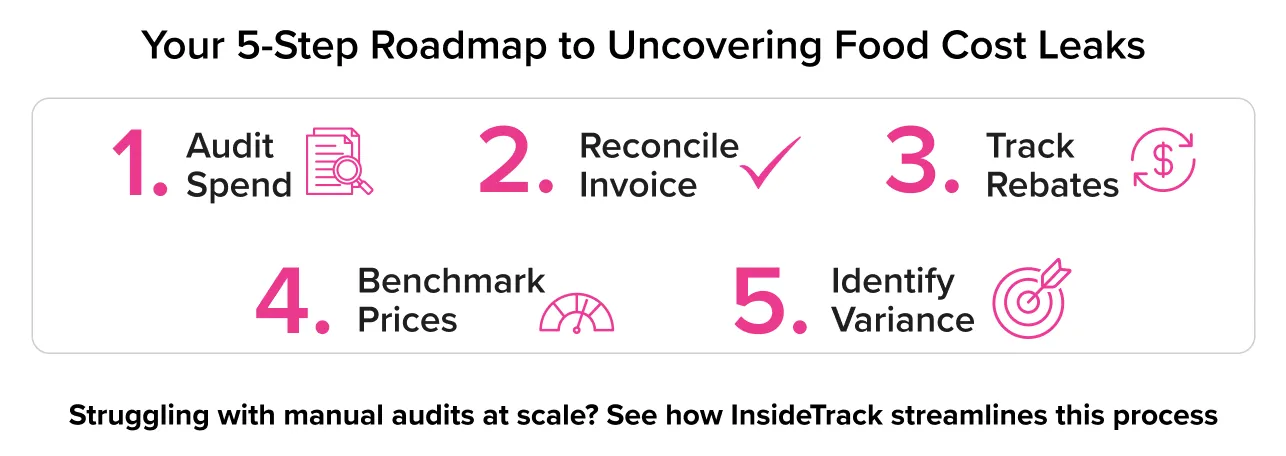
Step 1: Audit Spend Across All Distributors
If you buy from multiple distributors, pull together about 90 days of purchasing data and look at it as one complete picture instead of separate reports. Once everything is in one place, it’s much easier to spot off-contract purchases, duplicate buying, inconsistent pricing, or categories where spending is higher than expected.
Step 2: Reconcile Contracted Prices Against Invoices
Most operators assume the price on the invoice matches the price they negotiated. Unfortunately, that isn’t always the case. Take the time to compare invoices against your contract pricing because even a few cents more per case can turn into a meaningful expense when you’re buying the same products week after week across multiple locations.
Step 3: Track Rebate Eligibility and Recovery
It’s surprisingly easy to miss rebate dollars you’ve already earned. Maybe a product was purchased through the wrong distributor, maybe volume requirements weren’t met, or maybe the rebate was never submitted. Whatever the reason, it’s worth reviewing your rebate programs regularly to make sure those savings actually make it back to your operation.
Step 4: Benchmark Spend Against USDA Markets and Industry Data
When food prices increase, don’t assume there’s nothing you can do about it. Compare what you’re paying with USDA market reports and other industry benchmarks so you have context before accepting higher prices. Sometimes the increase makes perfect sense. Other times, it’s an opportunity to have a conversation with your supplier.
Step 5: Identify Variance Between Actual and Ideal Food Cost
If your actual food cost keeps coming in higher than your ideal food cost, that’s your cue to start asking questions. The gap usually points to something happening somewhere in the operation, whether it’s waste, portion sizes, inventory accuracy, purchasing practices, or receiving. The sooner you know where the difference is coming from, the sooner you can do something about it.
How to Solve Food Cost Problems with Smarter Sourcing
There’s no single fix for food cost problems. Most operators are dealing with several issues at once, from pricing discrepancies and missed rebates to limited visibility across distributors. The goal isn’t to chase those problems after they’ve already affected your margins. It’s to build a purchasing process that helps prevent them in the first place.
Unified Spend Visibility Across Distributors
When every distributor sends data in a different format, it’s tough to know what your operation is actually spending. Pulling everything into one view makes it easier to compare suppliers, identify unusual purchasing patterns, and catch issues that would be easy to miss if you’re jumping between reports.
Centralized Contract and Rebate Management
Contracts and rebate programs shouldn’t live in spreadsheets, emails, and filing cabinets. Keeping everything organized in one place makes it much easier to see whether locations are buying on contract and whether rebate opportunities are being captured instead of slipping through the cracks.
Automated Invoice Accuracy and Credit Recovery
Nobody enjoys digging through invoices looking for pricing mistakes. It’s repetitive work, and when you’re managing thousands of purchases, things get missed. Automating that process helps identify discrepancies sooner so your team can spend less time hunting for errors and more time solving bigger procurement challenges.
Price Competitiveness Benchmarking
Prices change. That’s part of foodservice. What matters is knowing whether the increase reflects what’s happening in the market or whether you’re paying more than you should. Benchmarking gives procurement teams another point of reference before accepting higher costs or renegotiating with suppliers.
Food Cost Problems in Multi-Unit and Enterprise Foodservice
The bigger the operation, the harder it becomes to keep food costs consistent. One location may be following purchasing standards while another is buying off contract. Different distributors, different managers, and different processes can all create unnecessary variation. Having consistent data across every location gives leadership a much clearer picture of where costs are increasing and where improvements can have the biggest impact.
Gain Full Visibility and Control Over Food Costs With InsideTrack
Food costs don’t usually get out of control overnight. It’s the little things that add up over time. A price that’s slightly higher than expected. A rebate that never gets paid. An invoice that slips through without anyone noticing a discrepancy.
InsideTrack helps bring those details together. Instead of pulling reports from multiple distributors or trying to piece everything together in spreadsheets, your purchasing data is available in one place. That makes it easier to see what’s happening across your operation, catch issues sooner, and spend less time trying to figure out where the money went.
Whether you’re reviewing distributor pricing, checking contract compliance, or keeping an eye on rebates, having better visibility makes those conversations a lot easier. You have the information in front of you, and that’s usually where better decisions start.
Looking for a better way to manage food costs across every location? Click here to contact InsideTrack and see how we help foodservice operators gain greater visibility into purchasing, pricing, and supplier performance.
Frequently Asked Questions
What Is the Most Common Cause of Food Cost Problems?
There’s rarely one answer. For some operators, it’s waste in the kitchen. For others, it’s pricing discrepancies, invoice errors, or purchases that fall outside negotiated contracts. More often than not, it’s several small issues happening at the same time. That’s why it’s important to look at the entire purchasing process instead of trying to find one thing to blame.
What Is a Healthy Food Cost Percentage for Restaurants?
A healthy food cost percentage varies by concept. Quick-service restaurants (QSRs) often aim for 25-30%, while full-service establishments might range from 28-35%. Hotel and casino outlets can vary widely based on their specific offerings and service levels. The most important factor is consistency and tight control relative to your own target percentage.
How Do Food Cost Problems Affect Profit Margins?
Every extra dollar spent on food is a dollar that isn’t available somewhere else. Maybe it’s labor. Maybe it’s equipment. Also, maybe it’s growth. That’s why small issues deserve attention. A handful of pricing errors or a little extra waste probably won’t sink the business, but those same issues repeated every day across multiple locations can have a real financial impact.
What Is the Difference Between Actual and Ideal Food Cost?
Think of ideal food cost as the number you planned for. It’s based on recipes, portion sizes, and expected sales. Actual food cost reflects what really happened after deliveries, inventory, waste, spoilage, and day-to-day operations. When those numbers don’t line up, it’s usually worth digging deeper to understand why.
How Can Multi-Unit Operators Control Food Cost Across Locations?
Consistency goes a long way. Standard recipes, purchasing guidelines, inventory procedures, and regular reporting all help keep locations moving in the same direction. The other piece is visibility. When leadership can see purchasing activity across every location, it’s much easier to spot trends and address issues before they spread.
How Does Hospitality Procurement Software Reduce Food Cost?
Hospitality procurement software, like InsideTrack, reduces food cost problems by providing real-time spend analytics, automating invoice processing and accuracy checks, centralizing contract and rebate management, improving inventory accuracy, and offering tools for price benchmarking and negotiation. This allows operators to make data-driven decisions, recover lost revenue, and proactively prevent cost overruns.