

Spend visibility has become a growing challenge for foodservice operators under pressure from every direction right now. Food costs continue shifting, labor remains unpredictable, and operators are expected to make faster purchasing decisions while protecting already-tight margins.
The problem is, many teams still do not have a clear view of where their spend is actually going.
Invoices live in one system. Distributor reports live somewhere else. Contract pricing sits in emails or spreadsheets. Rebates get tracked manually, if they get tracked at all. By the time someone notices pricing issues or unusual category spend, the damage is often already done.
That is why spend visibility has become such a major focus across foodservice operations. Operators want better visibility into purchasing activity, pricing accuracy, contract compliance, and overall spend performance before small issues turn into larger financial problems.
What Is Spend Visibility in Foodservice Operations?
Most operators already know where the big expenses are.
Food costs. Labor. Distribution. Supplies.
The problem is not knowing what you spend money on. The problem is actually seeing what is happening underneath all those purchases day after day.
That is where spend visibility comes in.
At its core, spend visibility means having a clear picture of where your money is going across the operation. Not just once a quarter when someone pulls reports together. All the time.
That includes things like:
- Invoice pricing
- Distributor purchases
- Contract pricing
- Rebates
- Category spend
- Price changes
- Purchasing trends between locations
For smaller operators, that may only involve a few vendors and a couple locations.
For larger restaurant groups or multi-unit operations? Totally different story.
Now you are talking about:
- Thousands of invoices
- Multiple distributors
- Different ordering behaviors by location
- Constant product substitutions
- Pricing changes happening every week
And that is usually where things start getting messy.
A lot of operators are still trying to piece everything together manually through spreadsheets, disconnected systems, email chains, and accounting reports that are already outdated by the time somebody reviews them.
The result?
Small pricing issues turn into larger margin problems before anyone notices.
The Three Pillars of Foodservice Spend Visibility
Spend visibility usually comes down to three big areas.
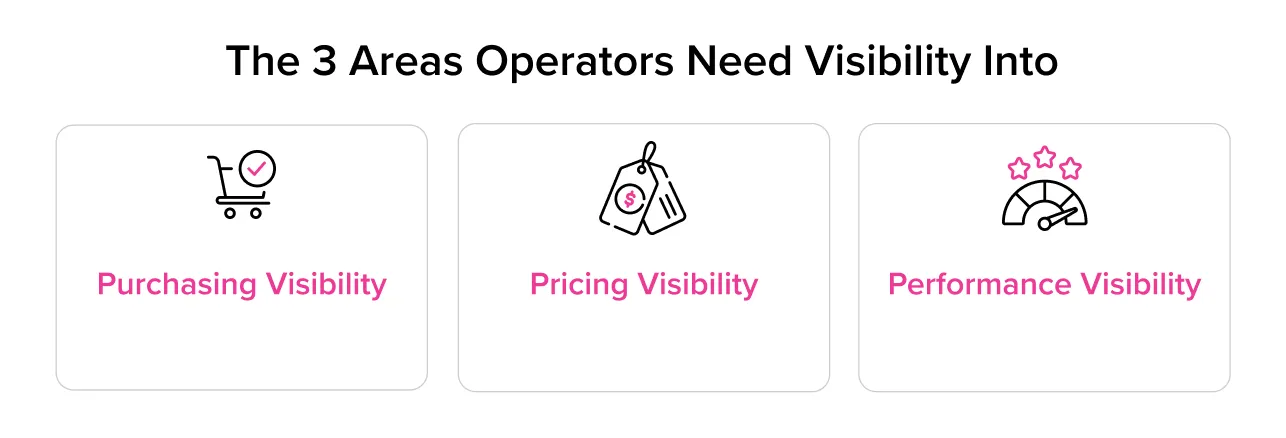
1. Purchasing Visibility
This is the basic “what are we actually buying?” part of the equation.
Operators need visibility into:
- What products locations are purchasing
- Which distributors they are buying from
- Whether purchasing behavior is changing
- Where category spend is increasing
Sounds simple.
But when different locations order differently or use different suppliers, it gets complicated fast.
One location may stay perfectly aligned with purchasing guidelines while another starts buying outside contract because somebody needed a quick substitute during a busy week.
Multiply that across dozens of locations and things drift quickly.
2. Pricing Visibility
This is where operators start uncovering the stuff that quietly hurts margins.
Things like:
- Contract pricing issues
- Invoice discrepancies
- Duplicate charges
- Unexpected price jumps
- Markup inconsistencies
And honestly, most teams do not have time to manually check every invoice line by line anymore.
A few extra cents on a product may not seem like a huge issue at first.
Until you realize that product gets purchased thousands of times a month across the system.
That is when operators start asking questions like:
“How long has this been happening?”
Usually longer than anybody wants to hear.
3. Performance Visibility
This is where purchasing data actually becomes useful operationally.
Instead of just seeing spend, operators can start evaluating performance across the business.
For example:
- Are locations following contract agreements?
- Which suppliers are driving the most spend?
- Are rebate programs actually being utilized?
- Which categories are fluctuating the most?
- Where are margins starting to tighten?
Without visibility, most of those answers involve digging through spreadsheets for hours.
With stronger reporting systems, operators can identify issues much earlier.
Spend Visibility vs. Spend Management vs. Spend Analytics
These terms get thrown around together constantly, but they are not interchangeable.
A simple way to look at it:
Spend Visibility
Spend Analytics
Understanding why it is happening.
Spend Management
Deciding what to do next.
They all work together, but visibility is usually the starting point.
Because if operators cannot clearly see purchasing activity, it becomes really difficult to control it.
Why Spend Visibility Is Critical for Foodservice Operators
Margins are already tight enough.
The last thing operators need is hidden purchasing problems quietly eating away at profitability behind the scenes.
And honestly, that happens more often than most people realize.
Not because teams are careless.
Because foodservice operations move fast.
A few common examples operators deal with regularly:
- Price discrepancies that go unnoticed
- Missed rebates
- Locations buying outside contract
- Inconsistent distributor pricing
- Duplicate purchases
- Inventory overordering
- Product substitutions with higher costs
Individually, they may not seem catastrophic.
Together?
They create serious operational leakage.
The Hidden Cost of Overcharges and Pricing Discrepancies
Most operators have experienced this at some point.
You negotiate pricing.
Everything looks good initially.
Then six months later somebody notices the invoices do not fully match the agreement anymore.
Now the finance team is scrambling to figure out:
- When the issue started
- Which locations were impacted
- How much was overcharged
- Whether credits are still recoverable
And usually the answer is not small.
The hard part is that these issues rarely show up as one giant mistake.
They show up as hundreds of tiny misses over time.
How Limited Visibility Hurts Margins Across Locations
This gets even harder for multi-unit operators.
Different locations order differently.
Different managers handle purchasing differently.
Some teams track rebates carefully. Others barely look at them.
Some locations follow purchasing guidelines consistently. Others work around them constantly during busy periods.
Eventually operators start seeing:
- Margin inconsistencies
- Supplier compliance issues
- Inventory waste
- Purchasing duplication
- Forecasting problems
The bigger the operation gets, the harder it becomes to manage manually.
Biggest Spend Visibility Challenges in Foodservice Operations
Most operators already know visibility matters.
The bigger question is usually:
“Why does this still feel so hard?”
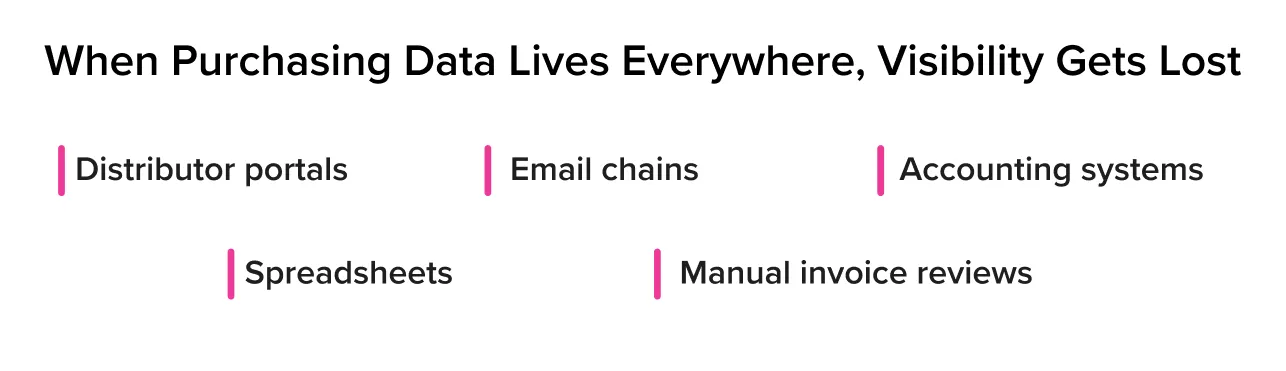
Here are some of the biggest issues foodservice teams run into.
1. Fragmented Purchasing Data Across Distributors and Locations
This is probably one of the biggest operational headaches.
Data lives everywhere.
Some reports come from distributors.
Some come from accounting.
Also, some come from spreadsheets somebody built three years ago that nobody fully understands anymore.
Trying to combine all of that into one usable view takes a ton of manual work.
2. Spreadsheet Chaos and Disconnected Back-Office Systems
Spreadsheets work…until they do not.
At some point operators hit a scale where manual tracking starts becoming unreliable.
Different versions get shared around.
Formulas break.
Reports stop matching.
And suddenly nobody fully trusts the numbers anymore.
That is usually when teams realize they have outgrown the process.
3. Manual Invoice Reconciliation and Missed Overcharges
Invoice review is one of those tasks everybody knows is important.
But realistically?
Most teams do not have enough time to manually audit every invoice against contract pricing every week.
Especially across large operations.
That is why pricing discrepancies often sit unnoticed for months.
4. Lack of Contract Compliance Visibility
A surprising number of operators cannot easily answer questions like:
- Which locations are buying on contract?
- Which suppliers are off-program?
- Where is compliance slipping?
Without visibility, purchasing consistency becomes difficult to manage.
Especially across franchise or decentralized operations.
5. Untracked Rebates and Missed Earning Opportunities
Rebate leakage happens constantly in foodservice.
Sometimes operators qualify for rebates and never realize it.
Other times purchasing thresholds get missed simply because nobody had visibility into progress throughout the quarter.
Manual rebate tracking creates a lot of room for missed opportunities.
6. Inconsistent Item Data Across Distributors
This one creates reporting nightmares.
The exact same product may appear completely differently depending on the distributor.
Different item names.
Different SKU structures.
And, different abbreviations.
Without standardized item mapping, comparing purchases across locations becomes extremely difficult.
7. No Real-Time Insight into Category Spend or Price Variance
Delayed reporting creates delayed reactions.
And in foodservice, pricing conditions can change fast.
By the time some teams identify a pricing spike or category issue, they have already been absorbing the higher costs for weeks.
That lack of visibility limits how quickly operators can respond operationally.
How to Overcome Spend Visibility Challenges: A 5-Step Framework
The good news?
Most spend visibility problems are fixable.
The bad news?
A lot of operators are still trying to solve modern purchasing complexity with outdated processes.
Usually, the answer is not adding more spreadsheets.
It is simplifying the way purchasing data gets organized, reviewed, and acted on across the operation.
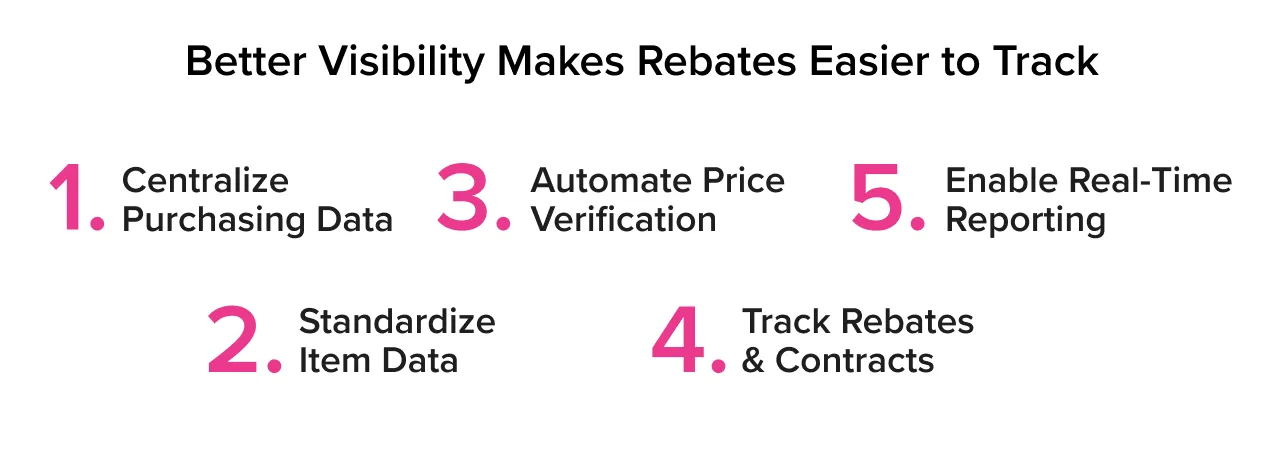
Here is where many operators start.
Step 1: Centralize Purchasing Data into a Single Source of Truth
This is usually the first major improvement.
Because when purchasing data lives across:
- Distributor portals
- Accounting systems
- Email threads
- Shared spreadsheets
- Individual locations
…it becomes almost impossible to get a clean operational view.
Centralizing purchasing data gives operators one place to evaluate:
- Spend by category
- Pricing activity
- Supplier performance
- Contract compliance
- Rebate participation
- Location-level purchasing behavior
It also cuts down the amount of manual reporting teams spend hours building every week.
And honestly, most operators would rather spend time fixing problems than hunting for data.
Step 2: Standardize Item Data with Manufacturer-Mapped Classification
This is one of the biggest reporting issues in foodservice and hospitality procurement.
Different distributors describe products differently all the time.
For example:
One distributor may call an item:
“CHK BRST FC 6OZ”
Another may list:
“Chicken Breast Fully Cooked 6 oz”
Same product.
Totally different reporting structure.
Now multiply that problem across thousands of SKUs.
Without standardized item mapping, category reporting becomes inconsistent very quickly.
Standardization helps operators:
- Compare purchasing across distributors
- Clean up reporting
- Improve category visibility
- Track manufacturer purchases more accurately
- Reduce reporting confusion across locations
It sounds like a small detail until reporting starts breaking because every supplier labels products differently.
Step 3: Automate Price Verification and Variance Alerts
This is where operators usually uncover the most hidden margin leakage.
Manual invoice review simply does not scale well anymore.
Not with the amount of pricing volatility happening across foodservice right now.
Automated price verification helps teams identify:
- Contract mismatches
- Unexpected price increases
- Duplicate charges
- Pricing inconsistencies between locations
- Unauthorized substitutions
And instead of finding those issues months later during audits, operators can catch them much faster.
That timing matters.
Because recovering credits six months later is usually a lot harder than preventing the overcharge in the first place.
Step 4: Track Contract Pricing and Rebate Performance
A surprising amount of money gets left on the table because operators cannot easily track rebate and contract performance consistently.
Sometimes locations buy outside contract without realizing it.
Sometimes purchasing thresholds get missed by a small amount.
Also, sometimes rebates simply are not tracked closely enough to identify gaps.
Better visibility helps operators answer questions like:
- Which locations are fully compliant?
- Which suppliers are underperforming?
- Are rebate programs actually driving participation?
- Where are contract gaps starting to appear?
The more visibility operators have into procurement performance, the easier it becomes to make adjustments before issues grow.
Step 5: Enable Real-Time Reporting Across Categories and Units
Delayed reporting creates delayed decision-making.
And foodservice moves too quickly for that now.
Operators need faster insight into things like:
- Category spikes
- Pricing fluctuations
- Purchasing inconsistencies
- Supply chain disruptions
- Inventory cost increases
The faster teams can identify changes, the faster they can respond operationally.
That does not necessarily mean reacting to every small fluctuation.
It means operators are not getting blindsided weeks later.
How to Evaluate Spend Visibility in Your Foodservice Operation
A lot of operators assume they have decent visibility until they start asking tougher operational questions.
For example:
Ask Yourself:
- Can you quickly identify invoice discrepancies?
- Can leadership compare purchasing behavior across locations easily?
- Are rebate opportunities consistently tracked?
- How long does invoice reconciliation currently take?
- Can your team spot unusual category spend quickly?
- Are contract compliance reports easy to access?
- Do purchasing reports feel reliable and current?
If the answer to most of those involves manual work, spreadsheet digging, or delayed reporting, there is probably room to improve visibility.
And honestly, that is pretty common across foodservice operations.
Especially for growing multi-unit groups.
Why Foodservice Spend Visibility Software Is Better Than Spreadsheets and Generic ERP
Most ERP systems were not built specifically for foodservice purchasing complexity.
Foodservice operations deal with constant movement:
- Price fluctuations
- Product substitutions
- Multiple distributors
- Manufacturer rebates
- Invoice volume
- Contract pricing changes
- Category volatility
Generic systems often struggle to keep up with those moving parts operationally.
And spreadsheets?
They usually work fine…until the business scales.
Then operators start running into:
- Broken formulas
- Reporting inconsistencies
- Duplicate data
- Version control issues
- Manual reconciliation overload
That is usually the point where teams realize the process is no longer sustainable.
Dedicated spend visibility software helps automate many of the tasks operators traditionally manage manually, including:
- Invoice auditing
- Price verification
- Contract monitoring
- Rebate tracking
- Category reporting
- Distributor normalization
- Spend analysis
The biggest advantage is not just automation.
It is operational clarity.
Teams spend less time trying to organize purchasing data and more time actually using it to improve decision-making.
Turn Spend Visibility into Smarter Purchasing Decisions
Spend visibility is not just a finance issue anymore.
It affects operations, procurement, inventory management, supplier relationships, forecasting, and overall profitability.
The operators with the strongest visibility are usually the ones identifying problems earlier, reacting faster, and making more informed purchasing decisions before margins start slipping.
And honestly, most margin problems do not appear overnight.
They build slowly through:
- Small pricing discrepancies
- Missed rebates
- Inconsistent purchasing
- Delayed reporting
- Lack of operational visibility
That is why stronger spend visibility matters so much right now.
Because operators cannot fix what they cannot clearly see.
Ready to get better visibility into your purchasing, pricing, rebates, and procurement performance? Click here to contact the InsideTrack team to learn how smarter spend visibility can support stronger operational decision-making.
Frequently Asked Questions
What is the difference between spend visibility and spend analysis?
Think of spend visibility as the ability to actually see where purchasing dollars are going across the business. Spend analysis is what happens after that. It is the process of digging into the data to spot trends, pricing problems, unusual spending patterns, or areas where costs may be creeping up over time.
How do foodservice operators achieve real-time spend visibility?
Usually by getting purchasing data out of disconnected spreadsheets and into one centralized system. A lot of operators also automate invoice reviews, pricing checks, and reporting so they are not waiting weeks to identify problems or unusual spending activity.
What data is needed to achieve full visibility into foodservice spend?
Operators generally need access to invoice data, distributor purchases, contract pricing, rebates, supplier information, and category-level reporting. Once all of that information is connected, it becomes much easier to understand where money is going and where issues may be hiding.
How does spend visibility help control food costs?
Better visibility helps operators catch problems earlier. That could mean spotting pricing discrepancies, identifying category spikes, finding locations buying outside contract, or uncovering missed rebates. Small issues tend to become expensive when nobody notices them quickly.
Can spend visibility software integrate with existing distributors and accounting systems?
In many cases, yes. Most foodservice spend visibility platforms are built to work alongside distributor systems, accounting software, ERP tools, and procurement platforms, so operators can pull purchasing information into one place instead of reviewing everything manually across multiple systems.