

Are foodservice rebates quietly impacting your profitability more than you realize?
If you ask most operators where margin disappears, they’ll usually point to food costs first. And honestly, they’re not wrong. Prices are still bouncing around, invoices rarely look the same week to week, and every extra expense feels bigger than it used to.
But one thing that gets overlooked a lot is foodservice rebates.
Not because operators do not care about them. Most just do not have the time to chase down spreadsheets, compare contracts, or figure out whether they actually received everything they were supposed to earn back.
The reality is, a lot of hospitality groups are already buying products that qualify for foodservice rebates every single week. The problem is that the dollars are harder to track than they should be.
And when margins are already tight, missed rebate dollars start to matter fast.
What Are Foodservice Rebates?
At the most basic level, foodservice rebates are money operators earn back after purchasing certain products.
Simple enough in theory. In practice? It gets messy fast.
Maybe a manufacturer is offering rebates on specific SKUs. Maybe a distributor has a volume program tied to purchasing thresholds. Also, maybe there’s a GPO agreement involved somewhere in the middle too.
That’s why foodservice rebates can feel confusing for a lot of operators. The opportunity is there, but the tracking side usually turns into a pile of reports, invoices, and emails nobody has time to sort through.
Still, those dollars matter.
Especially when margins are tight and every percentage point counts.
Foodservice rebates can apply to:
- Food and beverage purchases
- Chemicals and sanitation products
- Disposables and supplies
- Beverage programs
- Equipment agreements
- Contracted manufacturer items
Depending on the program, operators may receive rebate earnings monthly, quarterly, or through scheduled payout cycles tied to purchasing activity.
Foodservice Rebates vs. Discounts vs. Net Pricing
These terms get lumped together all the time in hospitality, but they are not exactly the same thing.
Discounts lower the price upfront.
Net pricing usually reflects pricing that has already been negotiated directly into the invoice.
Foodservice rebates work differently because the earnings happen after the purchase is made.
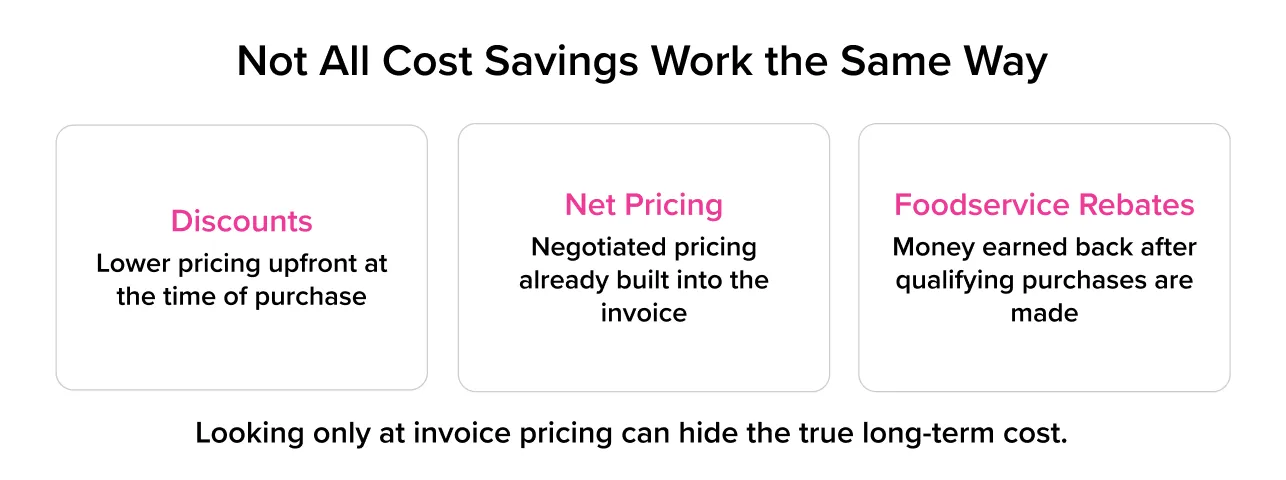
That distinction matters more than people think.
A product might not look like the cheapest option on the invoice at first glance. But once rebate earnings are factored in, the actual long-term cost could end up being much lower.
That’s why operators who only look at invoice pricing sometimes miss the bigger picture.
And honestly, it happens all the time when purchasing visibility is limited.
How Foodservice Rebates Directly Impact Profitability
Higher Margins Without Changing the Menu
One reason operators care so much about foodservice rebates right now is because they can improve margins without completely disrupting the operation.
Nobody wants to overhaul a menu every six months just to protect profitability. Guests already notice enough price increases as it is.
Rebates create another path.
Instead of changing the menu, operators can tighten up purchasing habits, improve compliance on contracted products, and make sure they are actually collecting the earnings tied to products they already use.
And honestly, that adds up faster than most people think.
Especially for operators running multiple locations or high-volume programs where the same products are getting ordered constantly.
Turning Existing Spend Into Recurring Revenue
A lot of operators think of foodservice rebates as occasional bonus checks.
But over time, rebate programs can start functioning more like recurring revenue tied directly to purchasing behavior.
The more consistent purchasing becomes, the easier it is to forecast rebate earnings and identify which categories are driving the strongest return.
For some operators, those earnings help offset rising costs elsewhere in the business.
For others, they create breathing room during tougher periods when margins get squeezed.
Either way, the dollars matter.
Reinvesting Rebate Earnings Into Growth
Most operators are not treating rebate earnings like “extra” money anymore.
They are putting those dollars back into the business.
That might include:
- Replacing equipment
- Investing in technology
- Supporting staff training
- Testing new menu items
- Expanding marketing efforts
- Improving operations across locations
For multi-unit hospitality groups, foodservice rebates can also help support purchasing consistency while reducing unnecessary spend leakage.
Types of Foodservice Rebate Programs You Should Know
Manufacturer Product Rebates
These are probably the most common foodservice rebates operators run into.
Manufacturers offer rebates on approved products to encourage loyalty and increase movement through distribution channels.
Usually, operators earn rebates by purchasing qualifying SKUs within a contracted agreement.
GPO and Group Purchasing Rebates
Many operators access foodservice rebates through GPO relationships.
The advantage here is scale.
Group Purchasing Organizations negotiate programs across large purchasing networks, which can create access to rebate opportunities operators may not be able to secure independently.
Distributor Loyalty and Volume Programs
Some distributors offer rebate or incentive programs tied to purchasing volume, loyalty thresholds, or category participation.
The tricky part is that these programs are not always easy to track consistently, especially across multiple locations or distributors.
Beverage and Category-Specific Rebates
Beverage programs are huge throughout hospitality.
Operators may see foodservice rebates tied to:
- Fountain beverage agreements
- Alcohol programs
- Coffee partnerships
- Energy drinks
- Specialty beverage categories
Some rebate programs also focus heavily on categories like proteins, produce, disposables, or sanitation products.
Multi-Unit and Chain Rebate Agreements
Larger restaurant groups and hospitality operators often negotiate broader rebate agreements tied to total purchasing volume across multiple locations.
Those programs can create significant earning opportunities.
But they also require stronger reporting and visibility to make sure locations stay compliant and rebate dollars are not slipping through the cracks.
Why Most Operators Leave Rebate Dollars on the Table
Manual Tracking and Missed Claim Deadlines
A lot of rebate dollars disappear for really unglamorous reasons.
Not because operators are careless.
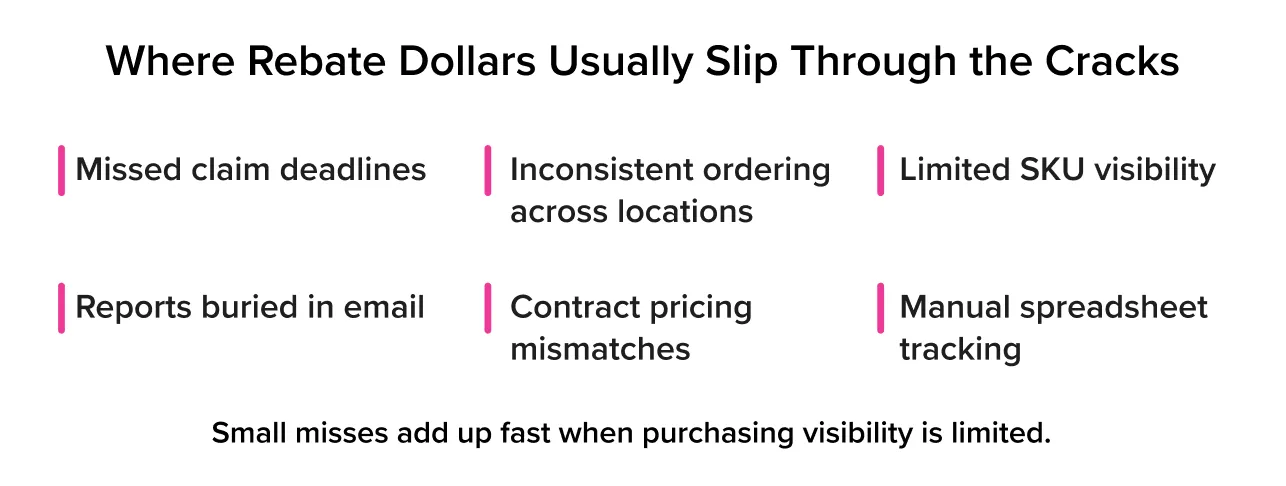
Usually it looks more like this:
- Someone forgot to submit documentation
- A deadline passed during a busy quarter
- Reports got buried in email
- Purchasing records were incomplete
- Different locations ordered inconsistently
Most hospitality teams already have enough on their plate operationally. Rebate tracking tends to become one more manual process nobody has time to babysit.
And unfortunately, that usually means money gets left behind.
Lack of Visibility Into Eligible SKUs
Another issue is simply not knowing what qualifies.
Operators may already be purchasing products eligible for foodservice rebates without realizing it.
That becomes especially difficult when:
- Multiple distributors are involved
- Purchasing data lives in separate systems
- Contracts are difficult to access
- Reporting is inconsistent between locations
Without centralized visibility, it becomes really hard to maximize rebate earnings consistently.
Contract vs. Invoice Discrepancies and Rebate Leakage
This is another area operators run into constantly.
Contract pricing does not always match invoice pricing perfectly.
Sometimes the discrepancy is small. Sometimes it is not.
But over time, those mismatches create rebate leakage that quietly chips away at profitability.
And manually comparing contracts against invoices line by line? Most teams simply do not have time for that.
How to Track and Maximize Foodservice Rebates
Step 1: Audit Current Supplier Contracts and Rebate Eligibility
A good starting point is figuring out what opportunities already exist.
A lot of operators are surprised by how many foodservice rebates they already have access to once they actually review their contracts closely.
That includes:
- Manufacturer agreements
- Distributor programs
- GPO participation
- Approved SKUs
- Category-specific incentives
Sometimes the opportunity is already there. It just has not been fully tracked.
Step 2: Centralize Purchase Data Across Locations and Distributors
Most operators are not short on data.
If anything, they’re drowning in it.
Invoices live in one place. Distributor reports live somewhere else. Contract details are buried in emails. Then somebody has a spreadsheet tracking rebate claims that only two people know how to use.
That’s usually where rebate earnings start slipping through the cracks.
Bringing purchasing data together creates a much clearer picture of:
- what qualifies
- what was purchased
- whether locations stayed compliant
- and where rebate opportunities are being missed
Step 3: Verify Pricing and Reconcile Claims Against Contracts
This step matters more than people realize.
If contract pricing and invoice pricing are not aligned, rebate calculations can become inaccurate pretty quickly.
Regular reconciliation helps operators catch:
- Pricing discrepancies
- Missed claims
- Incorrect invoices
- Non-compliant purchasing
- Supplier inconsistencies
And those smaller issues tend to stack up over time if nobody catches them early.
Step 4: Report on Rebate Performance and Reinvest Strategically
Operators should treat foodservice rebates like an actual profitability initiative, not random bonus money that shows up occasionally.
Consistent reporting helps teams understand:
- Total rebate earnings
- Strongest performing categories
- Purchasing trends
- Compliance gaps
- Long-term savings opportunities
The more visibility operators have, the easier it becomes to make smarter purchasing decisions moving forward.
Using Spend Visibility and Data Intelligence to Unlock Rebate Earnings
The biggest challenge with foodservice rebates usually is not access.
It’s visibility.
Most hospitality operators already have purchasing information spread across invoices, distributor systems, supplier contracts, and multiple reporting platforms. Pulling all of that together manually takes time most teams simply do not have.
Because when purchasing visibility is fragmented, it becomes almost impossible to know:
- what qualifies
- what was actually purchased
- whether pricing matched the agreement
- or whether the rebate was ever paid correctly in the first place
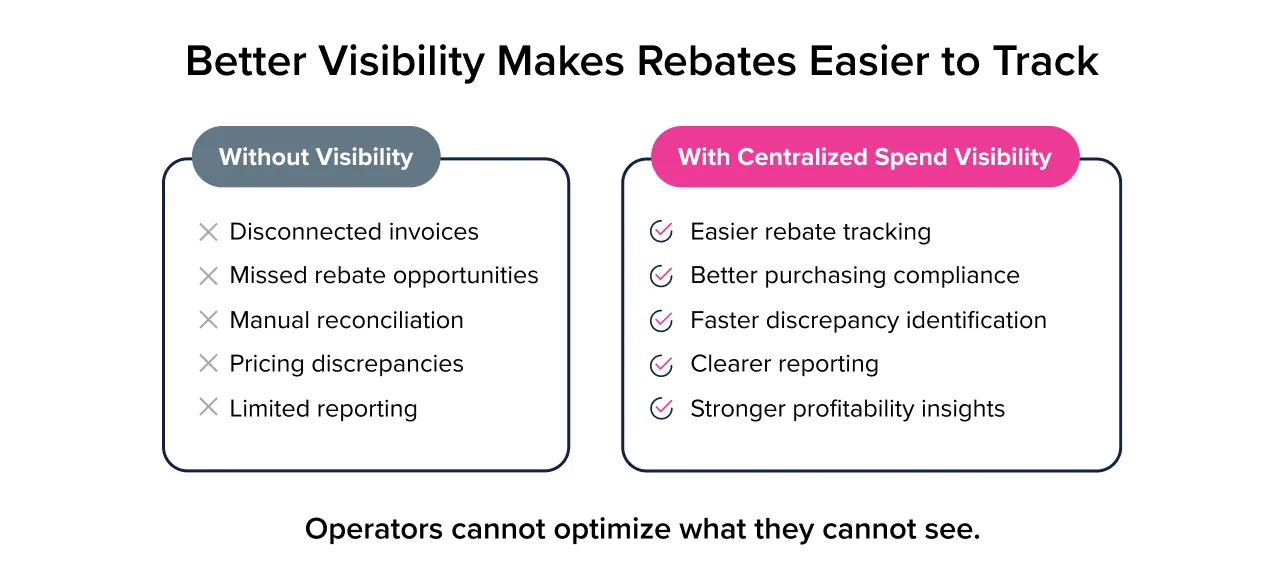
That’s why more hospitality groups are focusing heavily on spend visibility and purchasing intelligence right now.
Not because it sounds impressive in a presentation.
Because manually tracking foodservice rebates across multiple locations and distributors is exhausting.
Foodservice Rebates Across the Hospitality Sector
Independent and Multi-Unit Restaurants
Restaurants are using foodservice rebates to help offset rising ingredient costs without putting even more pressure on menu pricing.
Multi-unit operators are also using rebate reporting to improve purchasing consistency across locations.
Hotels and Resort Foodservice
Hotels and resorts manage purchasing across restaurants, bars, banquet operations, room service, grab-and-go programs, and catering functions.
That complexity creates major rebate opportunities.
But it also creates more room for missed claims, inconsistent purchasing, and rebate leakage if visibility is limited.
Catering, Country Clubs, and B&I Operations
Catering groups, country clubs, and business dining operations often deal with fluctuating purchasing patterns throughout the year.
Foodservice rebates can help stabilize costs while creating additional financial flexibility across seasonal operations.
Turn Foodservice Rebates Into a Profit Engine With InsideTrack
Foodservice rebates should not feel like hidden money nobody has time to track.
When operators have clearer visibility into purchasing activity, contracts, and invoice data, it becomes much easier to spot missed opportunities and reduce rebate leakage before it starts eating into margins.
Connect with InsideTrack to learn how hospitality operators are using spend visibility and purchasing intelligence to better manage foodservice rebates.
Frequently Asked Questions
How Do Foodservice Rebates Work?
Foodservice rebates are basically money operators earn back after buying qualifying products through approved suppliers or contracts. You buy the products first, then earn rebate dollars later based on what was purchased and whether it met the program requirements.
For a lot of operators, the harder part is not earning the rebates. It’s actually tracking them consistently.
Are Foodservice Rebates the Same as Manufacturer Rebates?
Not exactly. Manufacturer rebates are one type of foodservice rebate, but operators may also see rebates tied to distributors, GPO agreements, beverage programs, or category-specific incentives.
Sometimes multiple rebate programs are attached to the same purchasing activity, which is where tracking can get confusing pretty quickly.
How Much Can a Hospitality Operator Earn From Foodservice Rebates?
It depends on purchasing volume, supplier participation, and how closely the operation follows contracted programs.
For some operators, foodservice rebates help offset smaller monthly costs. For larger hospitality groups, rebate earnings can turn into a much more meaningful revenue stream over time.
How Long Does It Take to Receive a Foodservice Rebate?
Every rebate program works a little differently. Some foodservice rebates are paid monthly, while others follow quarterly or annual payout schedules.
Delays usually happen when purchasing records, invoices, or contract pricing do not line up correctly.
Do You Need a GPO to Access Foodservice Rebates?
No. Some foodservice rebates come directly from manufacturers or distributors without a GPO involved.
That said, GPOs can help operators access larger rebate programs and broader purchasing agreements through collective buying power.
How Can Operators Track Rebates Across Multiple Distributors?
This is where things usually get messy.
A lot of operators are juggling invoices, distributor reports, spreadsheets, and supplier contracts all in different places. That makes it harder to see what qualifies, what was earned, and whether anything was missed.
Centralized purchasing visibility helps make rebate tracking much easier across locations and distributors.
Who Pays Foodservice Rebates: Manufacturers, Distributors, or GPOs?
It can be any of them depending on the agreement.
Many foodservice rebates are funded by manufacturers, while others may come from distributor incentive programs or GPO-negotiated contracts. The important part is understanding where the rebate is coming from and whether the operation is actually capturing all eligible earnings.